

 Irish at Gallipoli

Irish at Gallipoli: Visiting V Beach, Cape Helles and Suvla in 2027
Irish units fought at Gallipoli from day one: the Dublins and Munsters at V Beach on 25 April 1915, the 10th (Irish) Division at Suvla in August. From Istanbul, V Beach needs a 2-day tour.
Irish soldiers fought at Gallipoli from the first morning of the landings. On 25 April 1915 the 1st Battalion, Royal Dublin Fusiliers and the 1st Battalion, Royal Munster Fusiliers landed at V Beach, at the tip of the peninsula, under fire that cut down hundreds of them; in August 1915 the 10th (Irish) Division, raised in Ireland the year before, landed at Suvla Bay. Estimates of the Irish dead run from more than 3,000 to about 4,000. To stand where the Dublins and Munsters came ashore you need Cape Helles, which our group day trip from Istanbul does not reach: our 2-day Troy, Cape Helles and Gallipoli tour stops at V Beach and the Helles Memorial, from $430 per person (≈ €392). Suvla is on no group itinerary and needs a private route.
Prices are in US dollars; the euro figures are approximate, at the European Central Bank reference rate of 18 November 2026 (€1 = $1.0968).
Photo: en:User:Jll, CC BY-SA 2.5, via Wikimedia Commons
The Irish at Gallipoli in 1915: who fought where
The Department of Foreign Affairs names the Royal Dublin Fusiliers, the Royal Munster Fusiliers, the Royal Inniskilling Fusiliers and the 10th (Irish) Division among the units that fought at Gallipoli. This is where they fought, and what you can visit today:
| When | Irish units | Where on the peninsula | What you can visit |
|---|---|---|---|
| 25–26 April 1915 | 1st Royal Dublin Fusiliers, 1st Royal Munster Fusiliers (29th Division) | V Beach and the village of Sedd el Bahr (Seddülbahir), Cape Helles | V Beach, V Beach Cemetery, the Helles Memorial |
| From 25 April 1915 | 1st Royal Inniskilling Fusiliers (29th Division) | X Beach, then Gully Ravine and the Helles front | The Helles sector |
| 7–8 August 1915 | 10th (Irish) Division, 30th and 31st Brigades | Suvla Bay: Chocolate Hill and Green Hill | Green Hill Cemetery, on request |
| Mid-August 1915 | 10th (Irish) Division | The Kiretch Tepe ridge, along the Gulf of Saros | Private route, on request |
| August 1915 | Battalions of the 10th Division at Anzac, among them the 5th Connaught Rangers | Chunuk Bair; Hill 60 on 21 August | Chunuk Bair is on our routes; Hill 60 on request |
| 21 August 1915 | 1st Inniskillings, 1st Munsters and Dublin Fusiliers | Scimitar Hill, Suvla | Private route, on request |
25 April 1915: the Dublins and Munsters at V Beach
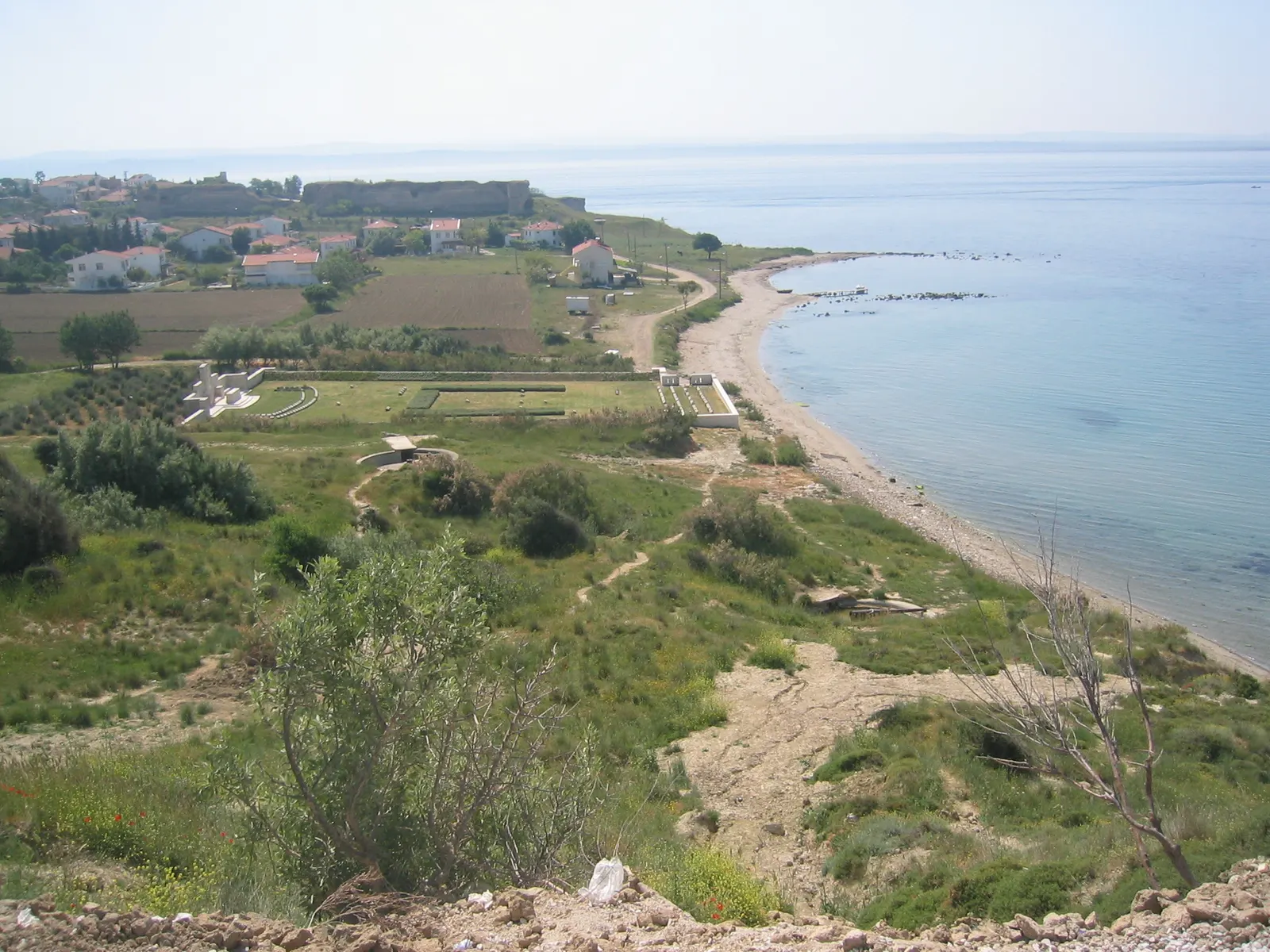
V Beach is a curve of sand about 300 yards long between Cape Helles and the old castle of Sedd el Bahr. In 1915 it was wired and held by about a company of the Ottoman 26th Regiment, with four Maxim guns. The 1st Dublins went in first, in ships' boats towed or rowed towards the shore, at about 6:30 a.m.; as the boats were about to land, the defenders opened fire. At the same time, the converted collier River Clyde was run aground with about 2,000 men aboard, among them the 1st Munsters, who were to leave through doors cut in her hull and cross a bridge of lighters. Many who came down the gangways were shot or drowned before reaching the sand, and the landing from the ship was suspended until dark.
On the morning of 26 April the survivors took the fort and village of Sedd el Bahr in an attack led by Lieutenant-Colonel Charles Doughty-Wylie, who was killed and awarded a posthumous Victoria Cross. Corporal William Cosgrove of the 1st Munsters, from Aghada in County Cork, won the regiment's first Victoria Cross of the war that morning; his citation says he "pulled down the posts of the enemy's high wire entanglements single-handed" under fire from front and flank. Cutting the wire with pliers, he said afterwards, was like trying to "snip Cloyne Round Tower with a scissors".
The 1st Dublins had just over 600 casualties in the first two days, out of just over 1,000 men who landed, and on 30 April what was left of the two battalions was merged into one, nicknamed the "Dubsters". The Ottoman defenders of the beach suffered too: by 27 April they had 575 casualties.
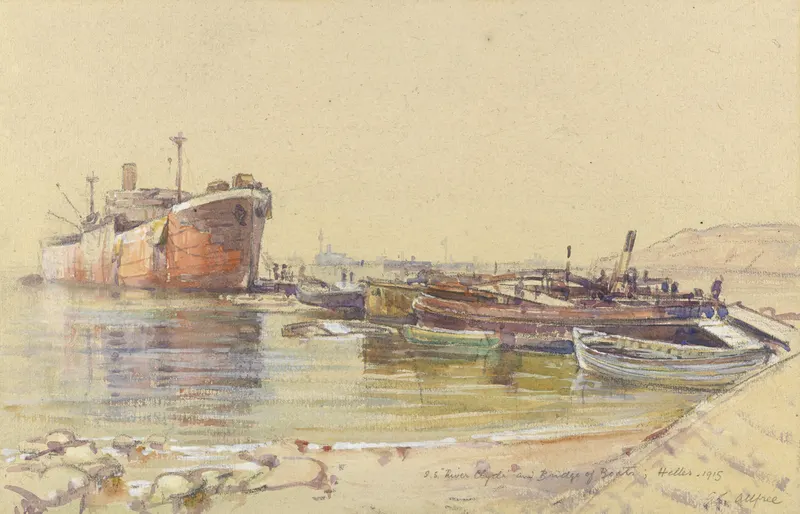
Photo: Geoffrey Stephen Allfree, public domain, via Wikimedia Commons
August 1915: the 10th (Irish) Division at Suvla
The 10th (Irish) Division was one of the first divisions of Kitchener's New Army, authorised on 21 August 1914 and formed in Ireland under Lieutenant-General Sir Bryan Mahon. On 7 August 1915, the morning after the first landings at Suvla, its 30th and 31st Brigades came ashore; some of its battalions were landed further south at Anzac and fought at Chunuk Bair.
Suvla was lightly defended, but the offensive stalled. The Dublins helped take Chocolate Hill on 7 and 8 August, at a heavy cost; it and Green Hill are parts of Yilghin Burnu, a hill on the eastern shore of the salt lake. In mid-August the division fought on the Kiretch Tepe ridge, on the northern side of the Suvla plain. On 21 August the 5th Connaught Rangers attacked at Hill 60 and took the wells at Kabak Kuyu, while at Scimitar Hill the 1st Inniskillings, brought up from Helles with the 29th Division, reached the summit and were driven off as the scrub burned around the wounded. In two months at Suvla, the Embassy of Ireland in London wrote in 2015, the division lost almost half of its 17,000 men through death, injury or sickness; it left in September.
Its men included the "Dublin Pals" of D Company, 7th Dublins, many of them Trinity College men and rugby players, and the Meath poet Francis Ledwidge of the Inniskilling Fusiliers, who wrote "The Irish in Gallipoli".
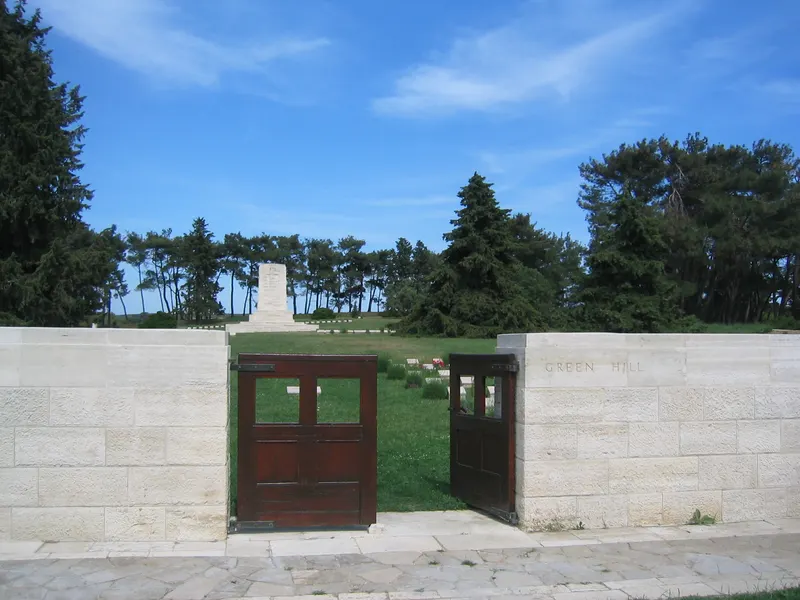
Photo: Jll at English Wikipedia, CC BY-SA 3.0, via Wikimedia Commons
How many Irish died at Gallipoli, and how Ireland remembers them
There is no single agreed figure. RTÉ, reporting President McAleese's visit in March 2010, gave "over 3,000 Irish soldiers"; the Department of Foreign Affairs' annual report for 2015 says at least 3,500 men from across the island of Ireland died and several thousand more were wounded; RTÉ's Century Ireland guide puts the Irish dead at approximately 4,000 of some 130,840 deaths in the campaign. The DFA notes that not every soldier in the Irish units was Irish, and President Higgins's 2015 programme noted that many first-generation Irishmen died at Gallipoli in Australian and New Zealand units.
On 24 March 2010 President Mary McAleese spoke at V Beach, in what RTÉ called the first official recognition by the State of Irish involvement in the landings, and on 24 April 2015 President Michael D. Higgins attended the Commonwealth and Ireland commemoration at Cape Helles.
Where the Irish dead are buried, and how to trace a soldier
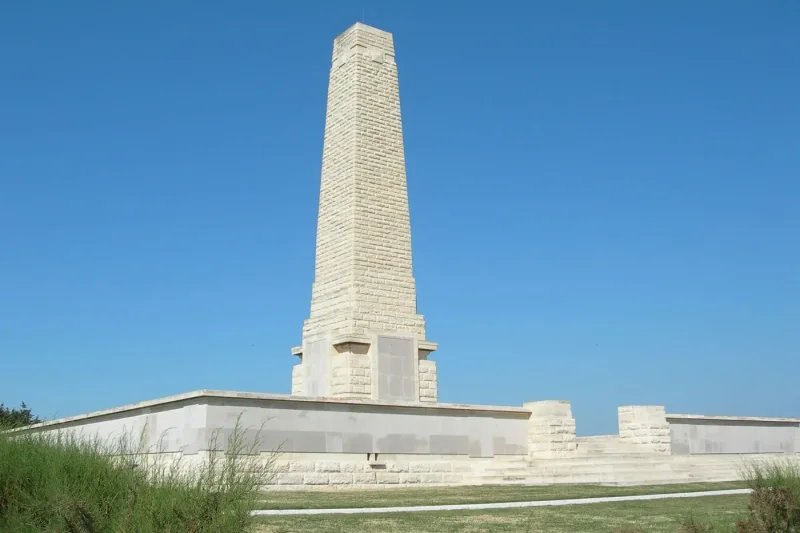
- The Helles Memorial. An obelisk more than 30 metres high, the main Commonwealth memorial for the campaign, it names almost 21,000 servicemen with no known grave. Its British and Indian soldiers died anywhere on the peninsula, so men of the Irish regiments with no known grave are named here, wherever they fell.
- V Beach Cemetery. Used in April and May 1915, it holds 696 servicemen buried or commemorated; only 20 graves are identified, and special memorials name 196 more men, nearly all from the units that landed on 25 April, known or believed to be buried there. Captain Garth Walford, awarded a posthumous Victoria Cross with Doughty-Wylie, is buried here. After storm damage early in 2026, the CWGC said in August 2026 that the cemetery remains open but is entered by a temporary route, and that the special memorials from the damaged area have been moved for now to its Anzac base site for their protection.
- Green Hill Cemetery. At Suvla, on Yilghin Burnu, it was made after the Armistice from graves on the battlefield and in small burial grounds nearby.
- Irishmen in Australian and New Zealand units. Those with no known grave at Anzac are named on the Lone Pine, Hill 60 or Chunuk Bair memorials; Australians who fell at Helles are on the Helles Memorial, New Zealanders on the Twelve Tree Copse Memorial.
To find a soldier, search the Commonwealth War Graves Commission's casualty records (cwgc.org) by name and regiment; the record gives the grave reference or memorial panel. The regiment is a clue to the county: the Royal Munster Fusiliers, depot Tralee, was the county regiment for Cork, Clare, Limerick and Kerry, and the Royal Dublin Fusiliers, depot Naas, served Dublin, Kildare, Wicklow and Carlow; both were disbanded in 1922. Our page on Gallipoli battlefield tours from the UK lists the archives for war diaries. There are 31 Commonwealth war cemeteries on the peninsula, so send us the reference before you travel, and check the cemetery's own CWGC page for access notices.
How to visit from Ireland: one day, two days or a private route
From Dublin, Turkish Airlines and Pegasus fly nonstop to Istanbul in about four and a half hours; our page on an Istanbul city break from Dublin explains how the flight times shape your days. Irish citizens need no visa for up to 90 days, but the passport book needs 150 days' validity (details). From Istanbul the drive to the Dardanelles takes about five hours, and our group day trip covers the Anzac sector only.
| Tour | Format | V Beach and Cape Helles | Suvla | From, per person |
|---|---|---|---|---|
| Troy, Cape Helles and Gallipoli, 2 days | Group, a night in Çanakkale | Yes, on day two | No | $430 (≈ €392) |
| Cape Helles and Anzac from Çanakkale | Group day from Çanakkale or Eceabat, 08:30 to about 17:00 | Yes, in the morning | No | $211 (≈ €192) |
| Private Gallipoli tour from Istanbul | Private guide and van, 08:00 pick-up | The guide can adjust the route | On request | $405 (≈ €369) |
| Private Gallipoli day tour with lunch | Private, about 07:30 to 22:00 | No, the Anzac sector | Ask us | $372 (≈ €339) |
| Private Troy and Gallipoli with hotel, 2 days | Private, 5-star or boutique hotel | No, Anzac and Troy | Ask us | $535 (≈ €488) |
| Gallipoli day tour from Istanbul | Group, about 06:30 to 21:00, lunch | No, the Anzac sector only | No | $134 (≈ €122) |
For V Beach, the 2-day tour is the simplest plan: Troy and a night in Çanakkale, then a day from the Ottoman fortress of Kilitbahir through Achi Baba, V Beach and the Helles Memorial to Anzac Cove and Chunuk Bair, back in Istanbul at about 22:00. For Green Hill and Kiretch Tepe at Suvla, or for Hill 60, choose a private tour and name the cemetery or unit when you ask for a quote; we confirm in writing whether it fits the day before you book. The peninsula is also Turkey's place of remembrance for its own soldiers; the main Turkish memorial is the Çanakkale Martyrs' Memorial. If you would rather see the Anzac sector as part of a longer week in Turkey, our 7-day Gallipoli, Troy, Ephesus and Cappadocia tour starts with Anzac Cove, Lone Pine and Chunuk Bair before heading on to Troy, Ephesus and Pamukkale.
2027 dates for an Irish visit
- 18 March (a Thursday in 2027): Turkey marks the naval battle of 18 March 1915 with special ceremonies; it is not a public holiday.
- 24 and 25 April (Saturday and Sunday in 2027): in 2015 the Commonwealth and Ireland commemoration at Cape Helles was on 24 April and the Anzac dawn service on 25 April. Check the 2027 arrangements nearer the time; the DFA says the Embassy of Ireland in Ankara posts updates on X (@IrlEmbAnkara). For dawn service passes, see Anzac Day 2027 at Gallipoli.
- 7 August (a Saturday): the anniversary of the 10th (Irish) Division's landing at Suvla.
- 21 August (a Saturday): the anniversary of the attacks at Hill 60 and Scimitar Hill.
Whatever the date, there is little shade on the ridges: our tour notes advise a hat, sun cream and water in the warm months and a wind-proof layer in the cooler ones.
Tours that cover this
- Troy, Cape Helles and Gallipoli tour from Istanbul, 2 days: from $430 per person (≈ €392), with a night in Çanakkale and two lunches.
- Cape Helles and Anzac day tour from Çanakkale: from $211 per person (≈ €192), with lunch.
- Private Gallipoli tour from Istanbul: from $405 per person (≈ €369). Ask for Suvla or a specific grave.
- Private Gallipoli day tour from Istanbul with lunch: from $372 per person (≈ €339).
- Private 2-day Troy and Gallipoli tour with hotel: from $535 per person (≈ €488).
Our group tours run in English with licensed guides.
Send us your dates on WhatsApp (+90 545 307 67 88), with the soldier's name, regiment and CWGC reference if you have them, and we will reply with a written plan for the 2-day Cape Helles tour or a private route. Compare formats on Gallipoli tours from Istanbul and Gallipoli and Troy in 2 days, read Is Gallipoli worth visiting? and the Gallipoli destination guide, or see Turkey tour packages from Ireland for a longer trip.
Frequently Asked Questions
How many Irish died at Gallipoli?
Estimates vary from more than 3,000 to about 4,000: RTÉ reported over 3,000 in 2010, the Department of Foreign Affairs' 2015 annual report says at least 3,500 men from across the island of Ireland, and RTÉ's Century Ireland guide approximately 4,000. Not all soldiers in Irish units were Irish, and many Irishmen served with the Anzacs.
Which Irish regiments fought at Gallipoli?
The Royal Dublin, Royal Munster and Royal Inniskilling Fusiliers fought at Helles from 25 April 1915. In August the 10th (Irish) Division, with battalions of the Dublin, Munster, Inniskilling and Royal Irish Fusiliers, the Connaught Rangers, the Leinster Regiment, the Royal Irish Rifles and the Royal Irish Regiment, landed at Suvla and Anzac.
What happened at V Beach on 25 April 1915?
The 1st Royal Dublin Fusiliers landed from open boats and the 1st Royal Munster Fusiliers from the collier River Clyde, run aground as a landing ship, and hundreds were killed or wounded under Ottoman fire. The survivors took Sedd el Bahr the next morning, when Corporal William Cosgrove of Aghada won the Victoria Cross.
Is the River Clyde still at V Beach?
No. The collier stayed beached at V Beach as a quay and breakwater during the campaign, but she was refloated in 1919, repaired in Malta and sold to Spanish owners in 1920. She traded in the Mediterranean for decades and was scrapped in 1966.
Can I visit V Beach on a day trip from Istanbul?
Not on our group day trip, which covers the Anzac sector only. Our 2-day Troy, Cape Helles and Gallipoli tour, from $430 per person (≈ €392), stops at V Beach and the Helles Memorial on its second day. From a hotel in Çanakkale or Eceabat, the Cape Helles and Anzac day tour costs from $211 (≈ €192).
Can I visit Green Hill Cemetery, Kiretch Tepe or Hill 60?
Only on a private tour, on request. None of our group itineraries goes to Suvla or Hill 60, but with your own guide and van the route can be adapted: name the cemetery or unit when you ask, and we confirm in writing whether it fits the day. The private tour from Istanbul costs from $405 per person (≈ €369).
How do I find an Irish relative's grave at Gallipoli?
Search the Commonwealth War Graves Commission's casualty records by name and regiment. The record gives the cemetery and grave reference, or the memorial panel; men of the Irish regiments with no known grave are named on the Helles Memorial. Send us the reference, and a private guide can plan the day around it.
Has an Irish president visited Gallipoli?
Yes. President Mary McAleese visited on 24 March 2010 and spoke at V Beach, the first official recognition by the State of Irish involvement in the landings, according to RTÉ. President Michael D. Higgins attended the centenary commemorations in April 2015, including the Commonwealth and Ireland commemoration at Cape Helles on 24 April.
Sources: Department of Foreign Affairs, annual report 2015, "Commemorating Gallipoli" (dfa.ie, archived copy), and travel advice for Türkiye (ireland.ie, still current at 18 November 2026); Embassy of Ireland in London, "The Irish at Gallipoli" (ireland.ie, April 2015); Áras an Uachtaráin, programme and diary of President Higgins's visit to Turkey, April 2015 (president.ie); RTÉ News, "President McAleese visits Gallipoli", 24 March 2010, and RTÉ Century Ireland, "How Men Died at Gallipoli" and "Francis Ledwidge" (archived copies); Commonwealth War Graves Commission, V Beach Cemetery (including its August 2026 notice), Green Hill Cemetery and Helles Memorial pages (cwgc.org); Wikipedia articles on the Cape Helles and Suvla Bay landings, SS River Clyde, the Royal Dublin and Royal Munster Fusiliers, William Cosgrove, the 10th (Irish) Division, Scimitar Hill, Hill 60, the Helles Memorial, V Beach and Green Hill cemeteries, the war cemeteries and memorials on the Gallipoli Peninsula and the Gallipoli campaign; European Central Bank reference rate, 18 November 2026; Get Turkey Tours tour pages — checked 19 November 2026. DFA travel advice for Türkiye
Private tours in Gallipoli
Troy, Cape Helles & Gallipoli Tour from Istanbul – 2 Days
A 2-day trip from Istanbul to the Dardanelles: Troy on day one, a night in Canakkale, then the Cape Helles front and the ANZAC sector of Gallipoli on day two.
Cape Helles & Anzac Gallipoli Day Tour from Canakkale with Lunch
An 8-hour guided group day from Canakkale or Eceabat that covers both the British landing beaches at Cape Helles and the ANZAC battlefields, with lunch and entry fees.
Related guides
- Anzac Day 2027 at Gallipoli: Passes, Packages and a Week Plan
- Gallipoli Battlefield Tours from the UK: Cape Helles and Suvla Bay
- Gallipoli Day Trip from Istanbul: The 15-Hour Day, Stop by Stop
- Gallipoli Tour from Canakkale 2027: Half Day, Full Day or Helles
- Gallipoli Tours from Istanbul: Day Trip vs Overnight, Route, Prices
- Gallipoli and Troy in 2 Days from Istanbul: Route, Tickets, Tours