

 Pamukkale
 Travertines and Hierapolis (Pamukkale)
On a hillside at Pamukkale, warm springs full of minerals have built white travertine terraces, and the Roman spa town of Hierapolis sits at the top. A single ticket, €30 in 2026, gets you into both, and the terraces are walked barefoot.
Tours that visit Pamukkale Travertines and Hierapolis
Pamukkale & Hierapolis Shore Excursion from Kusadasi Port, Private
A private day from Kusadasi cruise port to Hierapolis and the white terraces of Pamukkale, returning in time for your ship to sail.
Ephesus Shore Excursion from Kusadasi: Sirince Village, Private Guide
Spend your Kusadasi port day on a private tour of Ephesus and the hilltop village of Sirince, with a guaranteed on-time return to your ship.
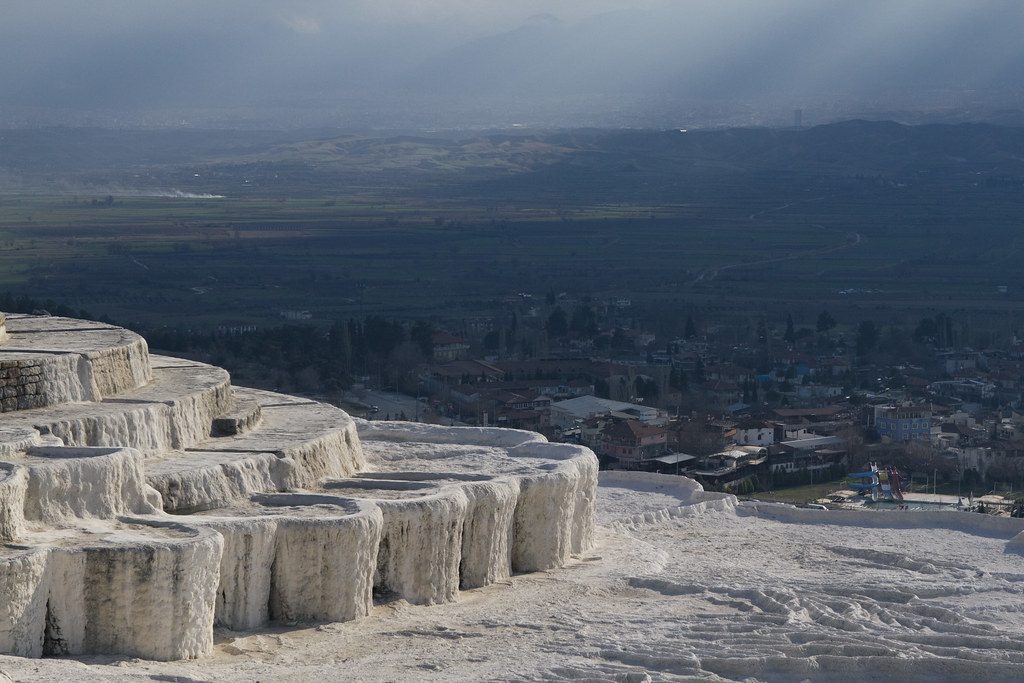
The white terraces at Pamukkale are travertine. This stone builds up when warm spring water carrying calcium carbonate runs down the slope and deposits its minerals as it goes. At the source the water is roughly 35 degrees Celsius. Hierapolis, a city of the Greek and Roman era that grew up around the springs, stands on the hilltop. Foreign visitors pay €30 in 2026 for one ticket that includes both.
Key facts
| Item | Details |
|---|---|
| Opening hours | 08:00-18:00, with the ticket office closing at 17:00 (as of October 2026, per muze.gov.tr). Hours are longer in summer |
| Closed | No closing day |
| Ticket for foreign visitors | €30 as of October 2026, valid for the travertines, Hierapolis and the Hierapolis Archaeology Museum. The Antique Pool charges separately for swimming; ask the price there. Museum Pass Turkiye accepted |
| Time needed | 3-4 hours, or a whole day if you add the pool and a long walk |
| Location | In Pamukkale village, roughly 20 km north of Denizli; around an hour from Denizli Cardak airport |
| Dress code | No shoes on the travertines; carry a bag for them, plus swimwear if you plan to paddle |
Choosing a gate
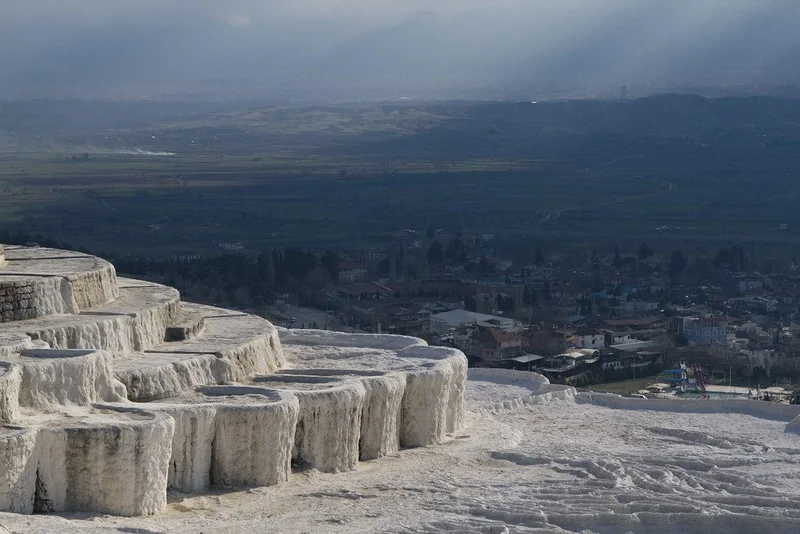
You can enter at three points. Most tours begin at the South Gate at the top, which leads in past the Hierapolis necropolis and along the ancient city's main street. The North Gate begins close to the northern necropolis. At the bottom, in Pamukkale village, the Town Gate lets you walk barefoot straight up the terraces, which is the most direct way onto them. Plenty of independent travellers come in from the village, climb the terraces, look around Hierapolis and then return downhill.
History in brief
Hierapolis was founded by the kings of Pergamon in the 2nd century BC. Under Roman rule it became a spa town that drew people seeking the healing waters. It was hit by earthquakes again and again. The city was a Christian centre too: tradition says the apostle Philip was martyred here, and in 2011 Italian archaeologists identified his tomb. In the 20th century, hotels went up on the travertines and drew off the water. They were pulled down after Pamukkale and Hierapolis were listed as a UNESCO World Heritage site in 1988, and today the water flow is managed to keep the terraces white.
Highlights
- The travertine terraces, crossed barefoot on a marked path past shallow, warm pools. Because the water is rotated to avoid damage, some pools are always dry.
- The Antique Pool, also called Cleopatra's Pool: a thermal pool with marble columns lying submerged on the bottom. There is an extra charge to swim.
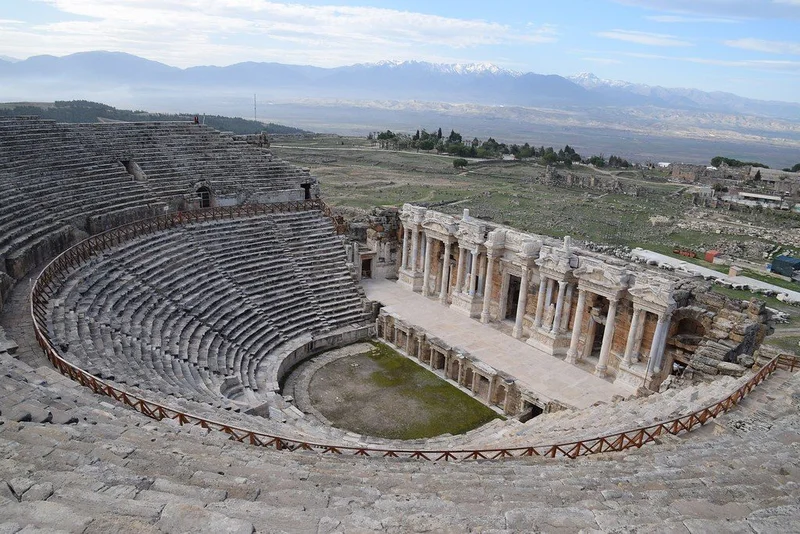
- The Theatre, restored, with a carved stage building and seating for roughly 12,000-15,000 people.
- The Necropolis, among the biggest ancient cemeteries in Anatolia, where hundreds of tombs line the road towards the North Gate.
- The Martyrium of St Philip, an eight-sided pilgrimage building on the hill behind the theatre.
- The Hierapolis Archaeology Museum, set in the former Roman baths and showing sculptures and sarcophagi.
When to go
Go early in the day, when the terraces are cooler and quieter, or late in the afternoon to watch the sun set over the plain. Summer sun bounces hard off the white stone, so pack sunglasses and sun cream. In winter the warm water feels good on the cold stone, and far fewer people come.
Our Pamukkale Day Trip from Istanbul by Plane covers flights, transfers, tickets and lunch in one ten-hour day, priced from US$499. If you are on the coast, the Antalya to Pamukkale & Hierapolis Tour takes eight hours and includes a guide, lunch, tickets and transfers from your hotel, from US$90.
Practical tips
- In places the travertine is rough underfoot, and elsewhere it is slippery. Go slowly and keep an eye on where water is running.
- Pack a small bag for your shoes, because you carry them all the way across.
- Guards use whistles when people step off the path; the pools beyond it are protected.
- Food on site is scarce and pricey. You will find simple restaurants in Pamukkale village.
- Staying the night pays off: sunset on the terraces and the empty site at opening time are the highlights of a visit.
See our Pamukkale destination page for more on the area.
FAQ
What is the Pamukkale entrance fee in 2026?
As of October 2026, foreign visitors pay €30, which includes the travertines, Hierapolis and the archaeology museum. Swimming in the Antique Pool costs extra.
Is swimming allowed at Pamukkale?
On the travertines you can paddle in the shallow pools but cannot swim. To swim, buy a separate ticket for the Antique Pool, also called Cleopatra's Pool.
Must you remove your shoes at Pamukkale?
Yes. To protect the stone, shoes are banned on the travertine terraces, so you walk the marked path barefoot or in socks.
How much time should I allow for Pamukkale?
Plan three to four hours for the terraces and the main sights of Hierapolis. Allow more for the museum and the Antique Pool, or stay the night to see the site at sunset.
Is Pamukkale worth the trip?
For most visitors, yes. White terraces together with a large Roman city make a combination found nowhere else. If you expect every pool to be full of turquoise water you may be let down, because the flow is rotated.