

旅行小贴士2026年11月18日14 分钟阅读
蓝色清真寺与圣索菲亚大教堂:区别、门票与先看哪个
同一广场上的两座建筑:蓝色清真寺与圣索菲亚大教堂在年代、规模与内部装饰上的差异,2026与2027年的入场费用,礼拜时段闭馆,以及如何一个上午游览两者。
本文
- Blue Mosque vs Hagia Sophia at a glance
- Two buildings, a thousand years apart
- Inside: mosaics under a dome, or tiles and light
- Tickets and entry rules in 2026 and 2027
- Prayer times, Fridays and the dress code
- Which is bigger, and which is better?
- Only time for one? How to choose
- Seeing both in one morning
- Tours that cover this
- FAQ
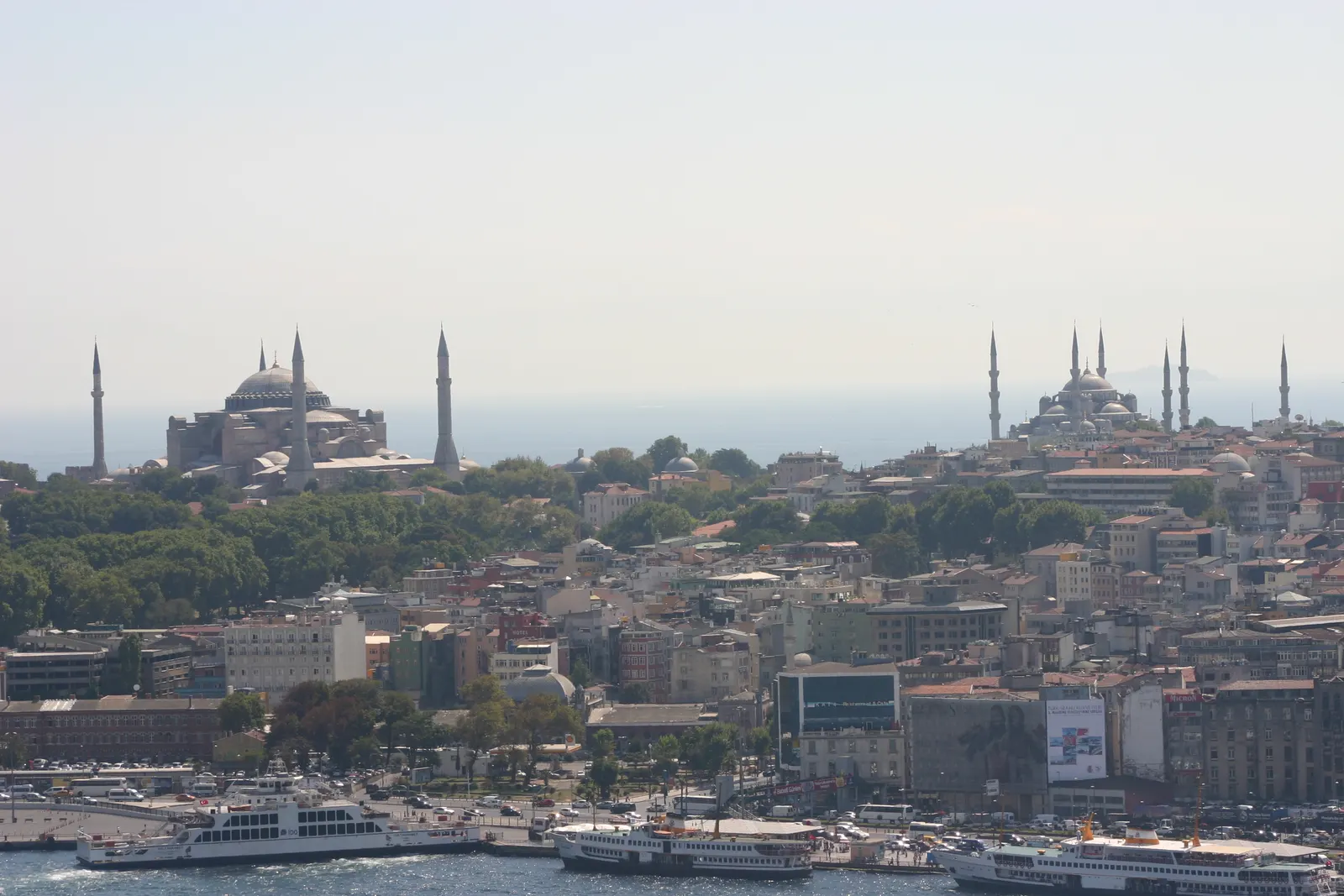
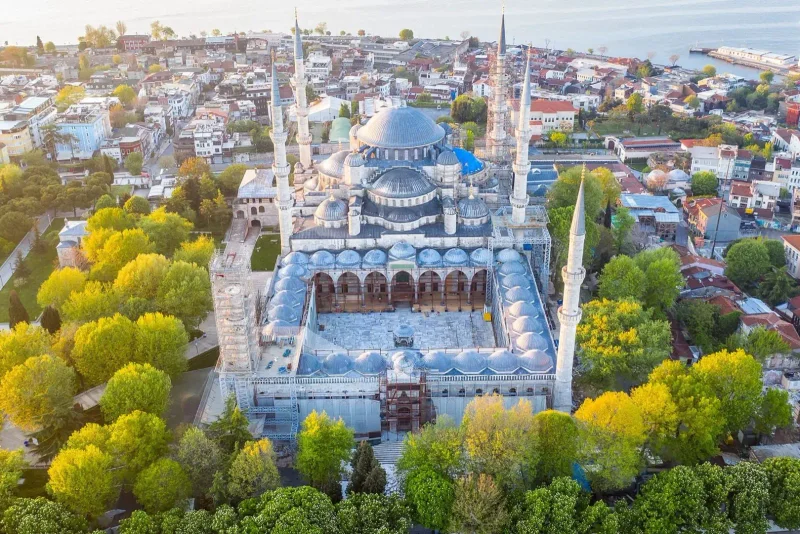
Hagia Sophia and the Blue Mosque are two different buildings that face each other across Sultanahmet Square, about a five-minute walk apart. Hagia Sophia is a 6th-century Byzantine cathedral, a mosque again since 2020, where foreign visitors pay €25 and see the interior from the upper gallery. The Blue Mosque is a 17th-century Ottoman mosque, free to enter, with a shorter visit. With time for only one, choose Hagia Sophia for history and mosaics, or the Blue Mosque for a free visit inside a working prayer hall. With one morning, you can see both: our Hagia Sophia small-group tour with the Blue Mosque costs from $120 per person, with the Hagia Sophia ticket included.
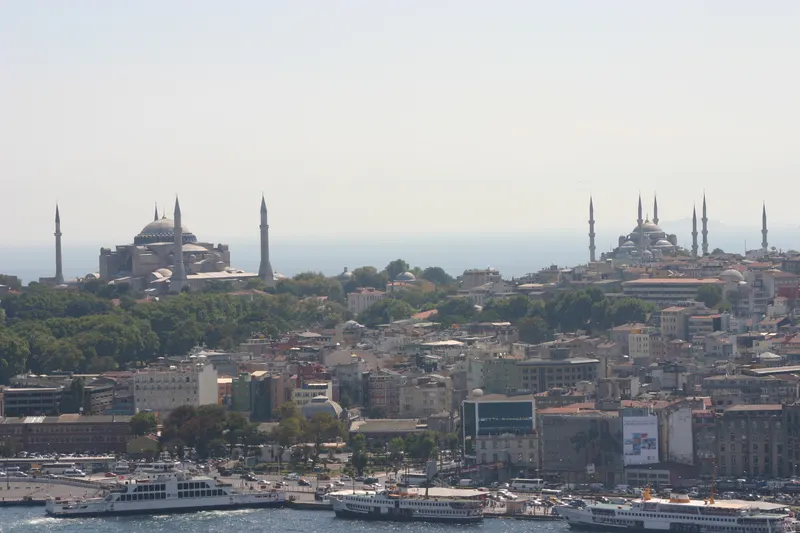
Photo: José Luiz Bernardes Ribeiro, CC BY-SA 3.0, via Wikimedia Commons
Blue Mosque vs Hagia Sophia at a glance
| Hagia Sophia | Blue Mosque | |
|---|---|---|
| Official name | Ayasofya-i Kebir Camii (Hagia Sophia Grand Mosque) | Sultan Ahmed Mosque (Sultanahmet Camii) |
| Built | Completed in 537 for Emperor Justinian | Begun in 1609 for Sultan Ahmed I; the whole complex was finished by 1620 |
| First use | Cathedral, for 916 years | Imperial mosque |
| Today | A mosque again since 2020; it was a mosque from 1453 and a museum from 1934 to 2020 | A working mosque; restoration begun in 2018, reported complete by the ministry in February 2026 |
| Entry for foreign visitors | €25 for the upper-gallery route, since 15 January 2024 | Free, no ticket |
| What you see inside | The domed hall from the galleries, Byzantine mosaics such as the Deësis, Ottoman calligraphy | A carpeted prayer hall under a central dome and four semi-domes, decorated with 21,043 tiles |
| Time with a guide | 60 to 90 minutes, plus the queue | 30 to 45 minutes |
| Closures | Visitor entry pauses at the five daily prayers, longest at Friday midday | Closed for about 60 to 90 minutes around each prayer, and on Fridays until about 14:30 |
| Minarets | Four, all added in the Ottoman period | Six |
| Main dome | About 31 m across, up to 55.6 m above the floor | 23.5 m across, 43 m high |
The sources for each figure are listed at the end of this page. Visit times and prayer closures are what our guides plan for, as set out on our Blue Mosque tour and Hagia Sophia guided tour pages.
Two buildings, a thousand years apart
Hagia Sophia is the older by more than a thousand years. The Ministry of Culture and Tourism's Kültür Portalı explains that it is the third church on the site: the churches of 360 and 415 were both destroyed in riots. Emperor Justinian had the present building raised by Anthemios of Tralles and Isidoros of Miletus in only five years and ten months. Completed in 537, it remained the largest church in the world for more than five hundred years.
It served as a church for 916 years. After Mehmed II took the city in 1453 it became a mosque, gaining mihrabs, a minbar and muezzin galleries in the 16th and 17th centuries. It was turned into a museum in 1934 and became a mosque again in 2020, which is why visitors now share it with worshippers.
The Blue Mosque is purely Ottoman. Sultan Ahmed I commissioned it from Sedefkâr Mehmed Ağa, one of the architects trained by Mimar Sinan; work began in 1609, and the ministry dates the completion of the whole complex to 1620. It was built on the south-east side of the old Byzantine Hippodrome, directly across from Hagia Sophia, which served its Ottoman architects as a source of inspiration. Our Sinan mosques of Istanbul guide follows his work across the city, and Byzantine vs Ottoman Istanbul puts both buildings on one timeline.
One name causes confusion: İznik, ancient Nicaea, has its own Hagia Sophia, a different, smaller building, covered on our İznik day trip from Istanbul page.
Inside: mosaics under a dome, or tiles and light
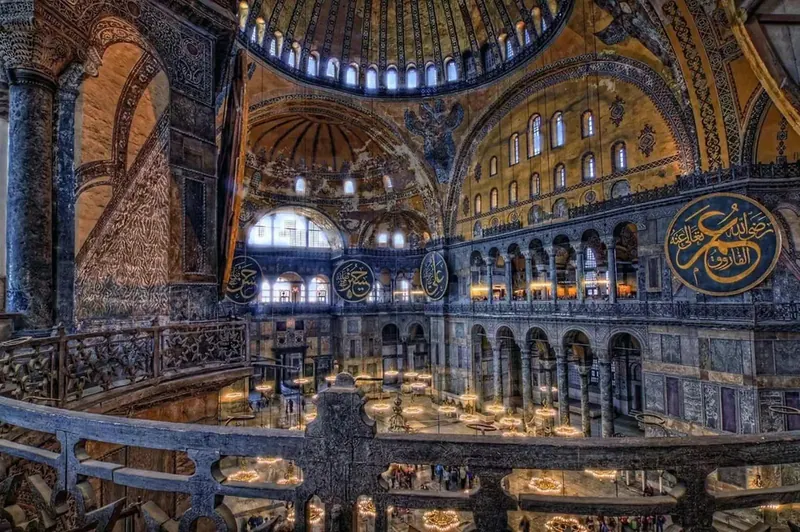
Hagia Sophia. Since 15 January 2024, foreign visitors have entered by a tunnel and ramp under the Bayezid II minaret on the south side, walked the gallery floor and left by a ramp on the north-east side, according to the ministry's announcement reported by Daily Sabah. From the galleries you look down into the prayer hall and its Ottoman additions, pass through the marble Gate of Heaven and Hell and see the Byzantine mosaics up close, with information in 23 languages through a QR code and headphones.
The mosaic most visitors come for is the Deësis in the upper galleries: Christ between the Virgin Mary and John the Baptist, probably from around 1261 and widely considered the finest in the building. The 11th-century Empress Zoe panel is in the southern gallery. The eight giant calligraphy roundels were designed by Kazasker Mustafa İzzet Efendi, who also wrote the Qur'anic verse in the main dome during the repairs of 1847 to 1849.
Expect scaffolding for now. In February 2026 the ministry said the restoration continues without closing the mosque to worship or visits, and that a 43.5-metre-high steel platform had been built inside, so expect it in your view of the dome. Our Hagia Sophia restoration update follows the work.
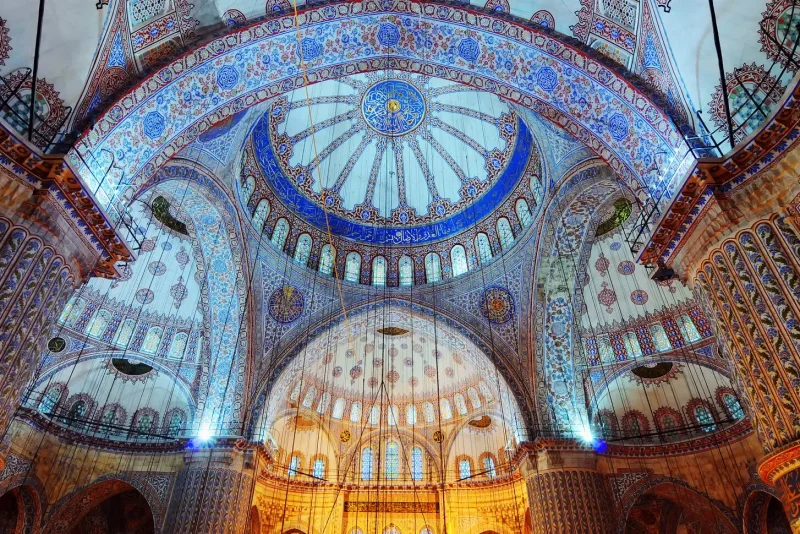
The Blue Mosque. Here you stay on the ground floor, in the visitor section of the carpeted prayer hall, while the main prayer area is roped off for worshippers. The plan is classical Ottoman: a central dome surrounded by four semi-domes. The ministry counts 21,043 tiles from İznik and Kütahya in more than fifty compositions, mostly naturalistic designs; Wikipedia lists cypress trees, flowers and fruit among the motifs and counts some 260 windows. Ahmed I's orders occupied the whole İznik tile industry during the building work, and in 1613 he banned the production and sale of tiles for any other purpose so that his commission would be finished on time.
The blue of the tiles and of the painted floral decoration gives the mosque its popular name. A restoration began in 2018, and in February 2026 the ministry reported the work at the Blue Mosque complete.
Tickets and entry rules in 2026 and 2027
The Blue Mosque has no ticket at all: anything sold online as "Blue Mosque tickets" is a guided tour, not admission. At Hagia Sophia the €25 fee is for foreign visitors who come to sightsee, and since January 2024 worshippers and sightseers have used separate entrances, so the prayer floor is not a way to skip the fee.
These are the prices for foreign visitors as checked on 18 November 2026:
| Ticket | Now | 2027 | Notes |
|---|---|---|---|
| Hagia Sophia, upper-gallery route | €25 | No change announced; we will update this page if one is | Charged since 15 January 2024; ticket booth opposite the Fountain of Ahmed III |
| Blue Mosque | Free | Free | Closed to visitors around prayers |
| Hagia Sophia History and Experience Museum | €25 | €30 from 1 January 2027 | A separate building on Sultanahmet Square; open every day 09:00 to 20:00, ticket office until 19:00 |
| Great Palace Mosaics Museum | €10, listed as closed on 18 November 2026 | €11 from 1 April 2027 | Mosaics from the Byzantine Great Palace, dated 450 to 550, in the Arasta market street below the Blue Mosque |
The History and Experience Museum is easy to confuse with Hagia Sophia itself. It occupies the old Defter-i Hakani building on Sultanahmet Square and tells Hagia Sophia's story in 13 halls, with commentary in 23 languages, but it is not Hagia Sophia itself; our update on the museum explains the difference, and the Hagia Sophia ticket price page covers the booth and the queue.
Prayer times, Fridays and the dress code
Both buildings are working mosques, so visits stop around the five daily prayers, whose times follow the sun. On 18 November 2026, for example, Diyanet's timetable for Istanbul gave the midday prayer at 12:54, the afternoon prayer at 15:27 and the sunset prayer at 17:51.
- Blue Mosque: closed to visitors for about 60 to 90 minutes around each prayer. On Fridays it closes for the late morning and the main weekly prayer, and visitors usually get back in around 14:30.
- Hagia Sophia: visitor entry pauses for each prayer. On Fridays it stops before noon and usually resumes in the afternoon.
- Opening hours: we found no official published timetable for the Hagia Sophia gallery route, so arrive early and allow for prayer pauses.
- 2027 dates: Ramadan begins on 8 February 2027, Eid al-Fitr falls on 9 to 11 March and Eid al-Adha on 16 to 19 May, according to Diyanet.
The dress code is the same at both doors. Women cover their hair, shoulders and arms and wear a skirt or loose trousers below the knee; men wear long trousers or shorts below the knee and no sleeveless tops. At the Blue Mosque shoes come off and go in a bag, so slip-ons help, and a scarf in your day bag saves time at both entrances. More in what to wear in Istanbul.
Which is bigger, and which is better?
Hagia Sophia is bigger. Its main dome is about 31 metres across, slightly elliptical after centuries of repairs, and rises up to 55.6 metres above the floor. The Blue Mosque's dome is 23.5 metres across and 43 metres high. The Blue Mosque has more minarets, six against four, and a large arcaded courtyard, so from the square it can look the larger of the two.
Which is better depends on what you want from the visit:
- For history and Byzantine art: Hagia Sophia, whose story as cathedral, mosque, museum and mosque again spans almost 1,500 years.
- For Ottoman decoration: the Blue Mosque, with its tiles and light, seen from inside the prayer hall rather than from a gallery.
- For cost: the Blue Mosque is free; Hagia Sophia is €25 per foreign visitor.
- For a short visit with children: the Blue Mosque, at 30 to 45 minutes, against 60 to 90 minutes plus a queue at Hagia Sophia.
The two make most sense side by side: the Blue Mosque was raised across the square from a building more than a thousand years older, and its architects learned from it.
Only time for one? How to choose
Pick by the day and the hour you have:
- A Friday morning only: Hagia Sophia, first thing. The Blue Mosque is closed to visitors until about 14:30 on Fridays.
- One free hour and no budget for tickets: the Blue Mosque, outside prayer times.
- You care about mosaics: Hagia Sophia, with time for the galleries.
- Half a day with a guide: both, plus the Hippodrome in between.
- A Tuesday: either, but keep Topkapı Palace for another day, because it is closed on Tuesdays.
Seeing both in one morning
The usual order is Hagia Sophia at opening time, when the queue is shortest, then across the square to the Blue Mosque before the midday prayer, with the Hippodrome monuments for a prayer break. On a Friday, leave the Blue Mosque for the afternoon. Our Blue Mosque tour page has a timed sample morning and our Hagia Sophia guided tour page shows how a guide plans around the prayers. The afternoon suits Topkapı Palace, closed on Tuesdays, or the Basilica Cistern.
Tours that cover this
- Hagia Sophia Small-Group Tour with Entry Ticket, Blue Mosque & Bazaar: from $120 per person. About six hours with a licensed guide: the Hippodrome, the Blue Mosque, Hagia Sophia and the Grand Bazaar, with the Hagia Sophia ticket and pick-up from central hotels or Galataport included.
- Istanbul Half-Day Morning Tour: Hagia Sophia, Blue Mosque & Bazaar: from $67 per person. 08:30 to about 12:30, ending at the Grand Bazaar rather than your hotel; ask us whether the Hagia Sophia ticket is included, and note that it does not run on Fridays.
- Istanbul Old City Tour: Small-Group Full Day with Tickets & Lunch: from $199 per person. About eight hours, adding Topkapı Palace and Hagia Irene; museum tickets and lunch are listed as included, drinks extra.
- Istanbul Old City Private Tour: Hagia Sophia, Topkapi & Grand Bazaar: from $200 per person. Six to eight hours with your own licensed guide, adding Topkapı Palace and the Basilica Cistern; museum tickets are extra and a private van is optional.
For your own guide for the whole group, the private Istanbul tour for 1, 2 or 3 days costs from $199 per group per day, tickets extra. The Topkapı Palace small-group tour, from $150 per person with the palace ticket, fills the afternoon, and the 3-day Istanbul package, from $435 per person, includes the Blue Mosque on its guided day, with the Hagia Sophia ticket extra. More choices are on our Istanbul tours page.
Send us your dates on WhatsApp (+90 545 307 67 88), with the day of the week you have for Sultanahmet, and we will reply in writing with the Hagia Sophia and Blue Mosque morning tour or the option that fits your day.
FAQ
Are the Blue Mosque and Hagia Sophia the same building?
No. They are two separate buildings facing each other across Sultanahmet Square, about a five-minute walk apart. Hagia Sophia is a Byzantine cathedral completed in 537 and now a mosque. The Blue Mosque, officially the Sultan Ahmed Mosque, was begun in 1609 and has always been a mosque. Count the minarets: Hagia Sophia has four, the Blue Mosque six.
Which is better, the Blue Mosque or Hagia Sophia?
Hagia Sophia is the more important building historically: it was the largest church in the world for more than five centuries and keeps its Byzantine mosaics. The Blue Mosque is better for Ottoman tiles and for standing inside a working prayer hall, and it is free. If you can, see both: they are a five-minute walk apart and fit into one morning.
Which is bigger, Hagia Sophia or the Blue Mosque?
Hagia Sophia. Its main dome is about 31 metres across and rises up to 55.6 metres above the floor, while the Blue Mosque's dome is 23.5 metres across and 43 metres high. The Blue Mosque has more minarets, six against four, and a large courtyard, so from the square it can look the bigger of the two.
How much are the Blue Mosque and Hagia Sophia tickets?
The Blue Mosque is free and has no ticket. Hagia Sophia costs €25 for foreign visitors, who follow a route through the upper galleries; this fee has applied since 15 January 2024 and no change for 2027 had been announced on 18 November 2026. The separate Hagia Sophia History and Experience Museum costs €25 and rises to €30 on 1 January 2027.
Why is it called the Blue Mosque?
Because of the blue of its interior. The ministry counts 21,043 tiles from İznik and Kütahya inside, mostly with naturalistic designs, and Wikipedia describes painted floral motifs in predominantly blue colours. Its official name is the Sultan Ahmed Mosque, Sultanahmet Camii in Turkish, after Sultan Ahmed I, who commissioned it.
How far apart are the Blue Mosque and Hagia Sophia?
They face each other across Sultanahmet Square, about a five-minute walk apart, with gardens and a fountain between them. The Hippodrome lies beside the Blue Mosque, and the Basilica Cistern and Topkapı Palace are a few minutes away on foot, so a guided day covers all of them without transport.
Can you visit Hagia Sophia and the Blue Mosque on a Friday?
Yes, but plan around the midday prayer. Visit Hagia Sophia first thing in the morning, because its visitor entry stops before noon and resumes in the afternoon. The Blue Mosque closes to visitors for the late morning and the Friday prayer and usually reopens around 14:30, so see it in the afternoon. Our half-day morning tour does not run on Fridays, according to its page.
Which should I visit first, Hagia Sophia or the Blue Mosque?
Hagia Sophia, as early as you can. Its queue grows through the morning, while the Blue Mosque's line moves faster because there is no ticket to check. Cross to the Blue Mosque before the midday prayer, and use the Hippodrome if a prayer break holds you up. On Fridays, keep the Blue Mosque for after about 14:30.
Do I need a guide for Hagia Sophia and the Blue Mosque?
Not to get in, but most visitors get far more from one. A guide explains the mosaics and the building's history, and plans the order around prayer closures and queues. Our morning small-group tour costs from $120 per person with the Hagia Sophia ticket included, and a private guide for the whole Old City starts from $200 per person, tickets extra.
Sources: Republic of Türkiye Ministry of Culture and Tourism, Kültür Portalı pages on Ayasofya-i Kebir Camii and Sultan Ahmed Camii (kulturportali.gov.tr), press release of 27 February 2026 on the Hagia Sophia and Blue Mosque restorations (ktb.gov.tr), museum pages for the Hagia Sophia History and Experience Museum and the Great Palace Mosaics Museum (muze.gov.tr) and the 2027 museum tariff as published by Alomaliye on 8 September 2026; Hürriyet Daily News, 15 January 2024 (hurriyetdailynews.com), and Daily Sabah, January 2024, on the Hagia Sophia visitor fee and route; Presidency of Religious Affairs (Diyanet), Istanbul prayer times for 18 November 2026 and 2027 religious days; Presidency of National Palaces, Topkapı Palace (millisaraylar.gov.tr); Wikipedia articles "Hagia Sophia" and "Blue Mosque, Istanbul" (dome dimensions, mosaics, tiles, restoration); Get Turkey Tours tour pages — checked 18 November 2026.
由Get Turkey Tours团队撰写:我们是总部位于伊斯坦布尔的持证本地导游和行程规划师。
发表评论
我们的私人游览
伊斯坦布尔半日上午游:圣索菲亚大教堂、蓝色清真寺与大巴扎
为期4小时的苏丹艾哈迈德早间导览步行游,涵盖赛马场、蓝色清真寺、圣索菲亚大教堂和大巴扎,约12:30结束,让您的下午保持自由。
相关文章
 旅行小贴士
Istanbul or Cappadocia: Which to Choose, Which First, How Many Days
Only time for one? Istanbul suits history and city lovers, Cappadocia balloons and valley walks. How to choose, which to see first, and how five or six days covers both from $840.
阅读更多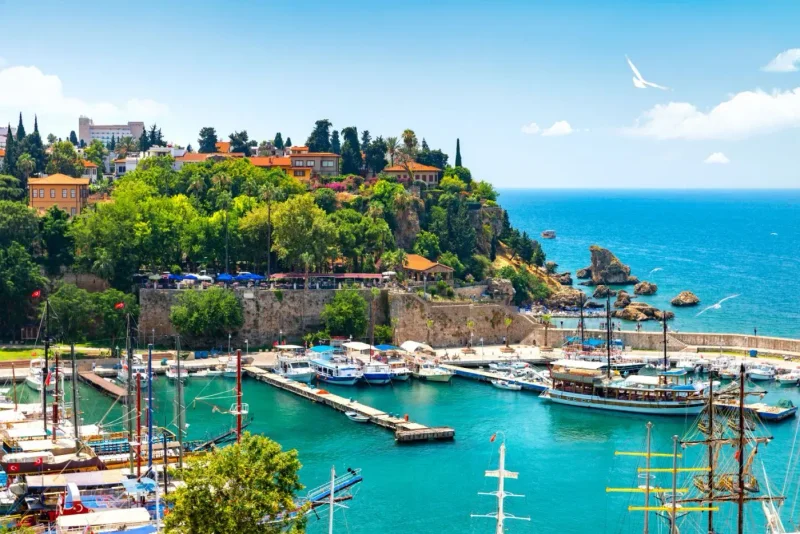 旅行小贴士
Cappadocia or Antalya: Valleys or Beaches, Month by Month in 2027
Antalya is for the sea and summer, Cappadocia for valleys and balloons in any season. Month-by-month weather and sea, 2027 ticket prices, and how to combine the two from $234.
阅读更多 旅行小贴士