

التحرك في المدينة6 نوفمبر 202614 دقيقة قراءة
إسطنبول لذوي الحركة المحدودة: المعالم والنقل المتاح
أي معالم إسطنبول خالية من الدرج وأيها تحتوي على درج، وكيفية عمل المترو والترام والعبّارات لمستخدمي الكراسي المتحركة، وقواعد الدخول المجاني للمتاحف، وخطة أبطأ لمدة يومين.
في هذا المقال
- What makes Istanbul hard, and what makes it easier
- Old City sights: what to expect at each one
- Sights beyond Sultanahmet that work well
- Getting around: metro, tram, ferry and car
- Free entry and tickets for visitors with a disability
- Hotels, restaurants and toilets
- Arriving at the airport
- A slower, step-light two-day plan
- Tours that cover this
- Frequently Asked Questions
Yes, Istanbul is manageable with limited mobility, but it takes more planning than most European capitals: the Old City is hilly and cobbled, many historic sights have steps, and pavements are often narrow and crowded. The good news is that the newer parts of the transport system are built for wheelchairs, several major sights are largely step-free, and visitors with a disability get free entry to state museums. This guide covers which sights work, which are difficult, how to get around and how to plan your days. If walking long distances is the main problem, a private driver tour in a Mercedes Vito takes the strain out of moving between sights.

What makes Istanbul hard, and what makes it easier
It helps to know where the problems are before you arrive.
The difficult parts
- Hills. Istanbul is built on hills. Sultanahmet sits on a ridge, and the streets down to the water at Eminönü and Sirkeci are steep. Galata and Beyoğlu, on the other side of the Golden Horn, are steeper still, with stepped streets in places.
- Cobbles and kerbs. Many Old City streets are paved with uneven stone. Kerbs are often high, dropped kerbs are inconsistent, and parked cars and shop displays narrow the pavement.
- Historic buildings. Mosques, palaces and Byzantine churches were not built with ramps. Many have steps at the entrance, thresholds or raised floors, and some have stairs inside.
- Crowds. At peak times the area around Hagia Sophia, the Grand Bazaar and the Spice Bazaar is very crowded, which is tiring if you walk slowly or use a wheelchair.
What helps
- Modern rail transport. Metro stations have lifts from street to platform, and the T1 tram through the Old City uses low-floor trams with ramped stations.
- Free museum entry. Visitors with a visible disability or a disability document enter Ministry of Culture museums and sites free of charge.
- Flat waterfronts. The promenades along the Bosphorus and at Galataport are level and wide, and good for a wheelchair.
- Private transport. Distances between sights are short by car, and a driver can drop you at the entrance rather than at the nearest tram stop.
Old City sights: what to expect at each one
This is how the main sights in and around Sultanahmet compare. Access changes when restoration work is under way, so ask at the gate on the day.
| Sight | Access in short | What to know |
|---|---|---|
| Hagia Sophia | Long sloping ramp, no stairs on the visitor route | Foreign visitors enter by a separate entrance and climb a ramp to the upper galleries. Long and steep in places |
| Blue Mosque | Shoes off at the door, flat carpeted interior | Courtyard is level stone; expect a threshold at the entrance and queues outside prayer times |
| Hippodrome and Sultanahmet Square | Open, mostly level squares | Paving is uneven in places; benches and shade under the trees |
| Topkapı Palace | Large courtyards, uneven paths, steps in the Harem | Closed on Tuesdays. The outer courtyards are manageable; the Harem is the hardest part |
| Basilica Cistern | Stairs at the entrance and exit | Raised walkways inside, which can be slippery and dim |
| Grand Bazaar | Mostly level covered streets with some slopes | Closed on Sundays. Very crowded at midday |
| Spice Bazaar | Level main hall | Narrow aisles and heavy crowds at busy times |
| Süleymaniye Mosque | Spacious, quiet courtyard | Reached by uphill streets from Eminönü; arrive by car to avoid the climb |
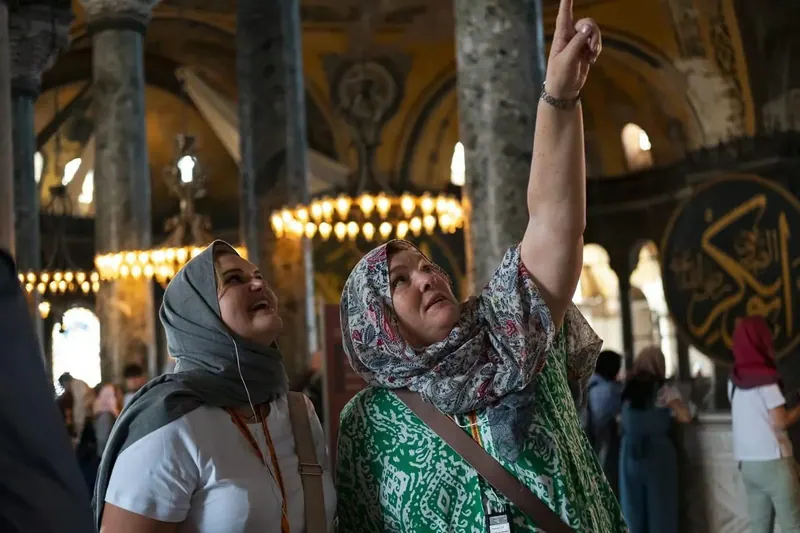
Hagia Sophia deserves a note. Since 2024 foreign visitors pay €25 and see the building from the upper galleries, reached by the long internal ramp that Byzantine builders used instead of stairs. There are no steps on the route, which makes it easier than you might expect for someone who cannot manage stairs, but the ramp is long, quite steep and paved with old stone. A manual wheelchair user will need a strong companion.
Topkapı Palace is spread over four courtyards connected by gates. Paths are a mix of stone and gravel, and the distances are long: allow more time than the usual two to three hours and use the benches. The Harem has narrow passages and steps, so many visitors with limited mobility skip it and focus on the courtyards, the kitchens and the Treasury.
The Basilica Cistern is underground and you go down by stairs at the entrance and up by stairs at the exit, so it is not suitable for wheelchair users. For someone who can manage steps slowly, it is short and worth it.
Sights beyond Sultanahmet that work well
Some of the city's best places are easier than the Old City:
- Istanbul Modern, Karaköy. The museum's building on the Galataport waterfront is new, and the museum says visitors with a disability enter free with one companion on showing a disability ID card. You can ask for a wheelchair on loan when you buy your ticket, and portable stools are available at the gallery entrances.
- Galataport promenade. The cruise-port waterfront between Karaköy and Tophane is flat and wide, with cafés and views of the Old City across the water.
- Galata Tower. Two lifts take visitors from the ground floor to the sixth floor, but the last two floors up to the viewing terrace are by steel stairs. The streets around the tower are steep and cobbled, so arrive by car or taxi rather than walking up from Karaköy.
- Dolmabahçe Palace. The gardens along the Bosphorus are level, but the visit inside includes a grand staircase to the upper floor. Closed on Mondays.
- The Bosphorus shore. The waterfront at Ortaköy, Bebek and Arnavutköy is level enough for a gentle walk, and Ortaköy Mosque sits right on the square by the water.
- Princes' Islands. The islands are car-free, and the small electric buses on Büyükada help with the hills. The ferry trip itself is restful.
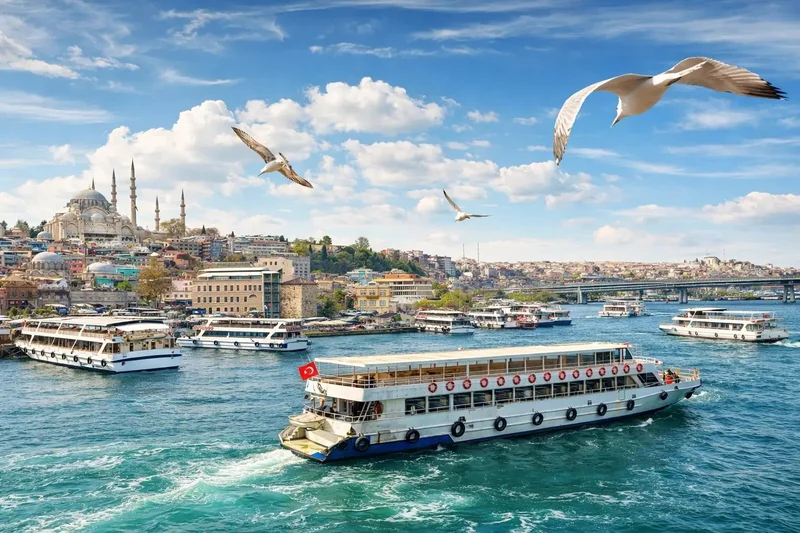
For a day that is easy on the legs, a Bosphorus cruise does most of the sightseeing from a seat. Our Bosphorus lunch cruise with hotel pick-up collects you from your hotel, which removes the hardest part: getting to the pier.
Getting around: metro, tram, ferry and car
Istanbul's public transport is a mix of new and old. The newer it is, the easier it is.
Metro. Metro Istanbul says its stations have lifts from street level down to the platform, ramps no steeper than 6 percent, tactile guide paths for visually impaired passengers and wider gates at some turnstiles. Lifts have audio and visual announcements and Braille buttons. Staff are trained to help passengers with a disability from the entrance to the train. Lifts do break down, and Metro Istanbul publishes a live list of out-of-service lifts on its website.
T1 tram. This is the tram most visitors use, running from Kabataş across the Galata Bridge to Eminönü, Sultanahmet and beyond. When the line switched to low-floor trams, all stations were lowered and ramps were built at the entrances, so it is the most useful line for a wheelchair user in the Old City.
Fares. A ride costs 46.20 TL with an Istanbulkart, the city's contactless card, since the last rise in July 2026. Residents with a disability travel free on a special card issued by the city, but short-stay visitors normally pay the standard fare.
Ferries. Şehir Hatları, the city ferry company, lists several boats designed for passengers with a disability. The passenger ferries ŞH Fatih, ŞH Kadıköy, ŞH Beykoz, ŞH Beyoğlu and ŞH Sarıyer have special boarding ramps, marked flat areas and wide corridors, and the company says passengers with special needs can use them without a companion. A number of other ferries have hydraulic boarding ramps. Not every boat on every route is adapted, so ask at the pier which ferry is next. For the main routes and fares, see our self-guided Bosphorus ferry guide.
Funiculars. The short F1 funicular links Kabataş on the waterfront with Taksim Square at the top of the hill, which saves one of the steepest climbs in the city.
Taxis and private cars. Ordinary yellow taxis are saloon cars, so they work for someone who can transfer from a wheelchair to a seat and fold the chair into the boot. For more space, a private van with a driver is easier: a folding wheelchair fits in the back, the driver waits while you visit, and he can drop you at the closest point to each entrance. See our page on hiring an Istanbul private car with driver.
Free entry and tickets for visitors with a disability
The Ministry of Culture and Tourism's rules for state museums and archaeological sites give free entry to disabled visitors, both Turkish citizens and foreigners. You need either a visible disability or a document showing your disability. The rules differ for companions: a Turkish citizen with a disability can bring one companion free, but the ministry's rules state that a foreign disabled visitor does not have a free companion right, so the person with you pays the normal ticket.
Ministry sites in Istanbul include Galata Tower, the Istanbul Archaeology Museums, the Turkish and Islamic Arts Museum and Rumeli Fortress. Some of the city's most visited places are run by other bodies and set their own rules:
- Hagia Sophia (the visitor route to the galleries)
- Topkapı Palace and Dolmabahçe Palace, run by the National Palaces Administration
- The Basilica Cistern, run by the Istanbul municipality
- Private museums, such as Istanbul Modern and the Pera Museum
At these, ask at the ticket desk and carry your disability card or a doctor's letter, ideally with an English translation. Children aged 8 and under also enter ministry sites free, which helps families travelling with a grandparent and young children together.
Hotels, restaurants and toilets
Hotels. Many Sultanahmet hotels are small boutique hotels in old townhouses. Some have tiny lifts that will not take a wheelchair, and some have no lift at all. Larger, newer hotels in Sirkeci, Karaköy, along the Bosphorus and around Taksim are more likely to have adapted rooms. When you book, ask three specific questions: the width of the lift door, whether the room has a step-free shower, and whether there are steps at the hotel entrance. Our guides to where to stay in Istanbul and Sultanahmet hotels compare the areas.
Restaurants. Old buildings often have a step at the door and toilets upstairs or downstairs. Waterfront restaurants and hotel restaurants are usually easier. Ask when you book whether the toilet is on the same floor.
Toilets. Mosques have public toilets nearby, usually for a small fee, but they are rarely adapted. Shopping centres, larger museums, the airport and the newer metro stations are the most reliable places for an accessible toilet.
Heat and timing. Summer afternoons are hot, and the hills feel twice as steep at 3 pm in July. Spring and autumn are the easiest seasons; see our guide to the best time to visit Istanbul.
Arriving at the airport

Istanbul Airport is very large, and walking distances from gate to passport control can be long. Book wheelchair or walking assistance with your airline when you book your ticket, and confirm it again before you fly. Airport staff meet you at the aircraft door and take you through passport control and baggage claim.
From the airport, the M11 metro runs to the city, but it involves changes, so most visitors with limited mobility are better off with a car. Our VIP airport transfer in a Mercedes Vito meets you in the arrivals hall, helps with luggage and takes you to the door of your hotel. Our page on Istanbul airport private transfers explains how the meeting works.
A slower, step-light two-day plan
This is how we would plan two days for someone who walks short distances or uses a wheelchair with a companion:
Day 1: Old City by car
- Morning: drive to the Hagia Sophia visitor entrance at opening time, before the queues. Take the gallery ramp at your own pace.
- Short break on Sultanahmet Square, then the Blue Mosque outside prayer times.
- Lunch near the Hippodrome.
- Afternoon: Topkapı Palace's outer courtyards and Treasury, skipping the Harem. Not on a Tuesday.
- Car back to the hotel.
Day 2: The water
- Morning: a Bosphorus cruise from a pier near your hotel, seated on deck.
- Lunch on the waterfront at Ortaköy or Bebek.
- Afternoon: Istanbul Modern and the Galataport promenade, with tea by the water.
Keep each day to two or three main stops with a rest in between. A licensed guide who knows the city will plan the order around entrances, ramps and lifts rather than the shortest walking route. If you want to see more of the city on a fixed private schedule, our sister site Get Istanbul Tours also runs private city tours.
Tours that cover this
These tours suit travellers who walk less, because they include private transport or hotel pick-up:
- Istanbul Private Driver Tour: Mercedes Vito for 8 Hours, 1-6 Guests: from $299 per group, a car and driver for the day.
- Istanbul Old City Private Tour: Hagia Sophia, Topkapı and Grand Bazaar: from $200 per person, with a licensed guide who can set the pace.
- Bosphorus Lunch Cruise with Hotel Pick-up and Drop-off: from $75 per person, 3 hours.
- Istanbul Airport VIP Transfer: Private Mercedes Vito to Your Hotel: from $60 per group.
Tell us about any mobility needs when you book, so we can plan the route and the order of the visits around them. The Istanbul destination guide has more on the city.
Frequently Asked Questions
Is Istanbul wheelchair friendly?
Istanbul is partly wheelchair friendly. The metro, the T1 tram and several ferries are adapted, and flat waterfronts such as Galataport and the Bosphorus shore are easy. The Old City is harder, with hills, cobbles, high kerbs and steps at many historic sights. Most wheelchair users manage well with a companion, a private car between sights and a plan built around step-free entrances.
Is Hagia Sophia wheelchair accessible?
Hagia Sophia's visitor route for foreign visitors has no stairs: it climbs to the upper galleries by a long ramp built in the Byzantine period. The ramp is steep in places and paved with old, uneven stone, so a manual wheelchair user will need a strong companion. Go at opening time to avoid crowds, and ask staff at the visitor entrance about current arrangements.
Can wheelchair users visit the Basilica Cistern?
The Basilica Cistern is difficult for wheelchair users, because visitors go down by stairs at the entrance and climb stairs at the exit. Inside, you walk on raised walkways that can be slippery and dimly lit. Visitors who can manage steps slowly usually find the short visit worthwhile. If stairs are not possible, Hagia Sophia's gallery ramp and the Hippodrome nearby are better choices.
Do disabled visitors get free entry to museums in Turkey?
Yes. Under the Ministry of Culture and Tourism's rules, visitors with a disability, foreign or Turkish, enter state museums and archaeological sites free, on the basis of a visible disability or a disability document. A foreign visitor's companion is not covered and pays the normal ticket. Palaces, the Basilica Cistern, Hagia Sophia and private museums set their own rules.
Is the Istanbul metro accessible?
Yes, largely. Metro Istanbul says its stations have lifts from street level to the platform, ramps no steeper than 6 percent, tactile paths and staff who help passengers with a disability. The T1 tram through the Old City uses low-floor trams with ramped stations. Lifts sometimes break down, so check Metro Istanbul's live list of out-of-service lifts before you travel.
Can I take a Bosphorus ferry in a wheelchair?
Yes, on adapted boats. Şehir Hatları lists passenger ferries such as ŞH Fatih, ŞH Kadıköy, ŞH Beykoz, ŞH Beyoğlu and ŞH Sarıyer with boarding ramps, flat areas and wide corridors, plus other ferries with hydraulic ramps. Not every boat is adapted, so ask at the pier. A private cruise with hotel pick-up avoids the walk to the pier altogether.
How do I get from Istanbul Airport to my hotel with a wheelchair?
Book assistance with your airline so staff meet you at the aircraft and take you through passport control and baggage claim. Then a private transfer is the easiest option: the driver meets you in arrivals, loads a folding wheelchair and takes you to the hotel door. The M11 metro also runs from the airport, but reaching the Old City needs changes.
Is Topkapı Palace suitable for people who cannot walk far?
Topkapı Palace is manageable if you take it slowly, but it involves a lot of walking across large courtyards on stone and gravel paths, and the Harem has steps and narrow passages. Many visitors with limited mobility see the outer courtyards, kitchens and Treasury and skip the Harem. The palace is closed on Tuesdays, so plan it for another day.
Sources: Metro Istanbul accessibility services page (metro.istanbul); Şehir Hatları "Disabled Guests" information (sehirhatlari.istanbul); Republic of Türkiye Ministry of Culture and Tourism directive on museum and site entry, exemptions list (muze.gov.tr); Istanbul Modern visitor guide (istanbulmodern.org); Galata Tower Museum building details as documented after the 2020 restoration; Istanbul Metropolitan Municipality public transport fares — checked 6 November 2026.
كتبه فريق Get Turkey Tours: مرشدون محليون مرخصون ومخططو رحلات مقيمون في إسطنبول.
اترك تعليقًا
جولاتنا الخاصة
جولة بسائق خاص في إسطنبول: مرسيدس فيتو لمدة 8 ساعات، من 1 إلى 6 ضيوف
سيارة مرسيدس فيتو خاصة بك مع سائق محترف ليوم في إسطنبول، تتسع لستة ركاب كحد أقصى، مع حرية تحديد المحطات والوتيرة.
رحلة الغداء في مضيق البوسفور في إسطنبول مع الاستلام والتوصيل من الفندق
غداء على متن السفينة أثناء الإبحار في مضيق البوسفور بين أوروبا وآسيا، مع مرشد ونقل ذهاب وعودة من فندقك.