

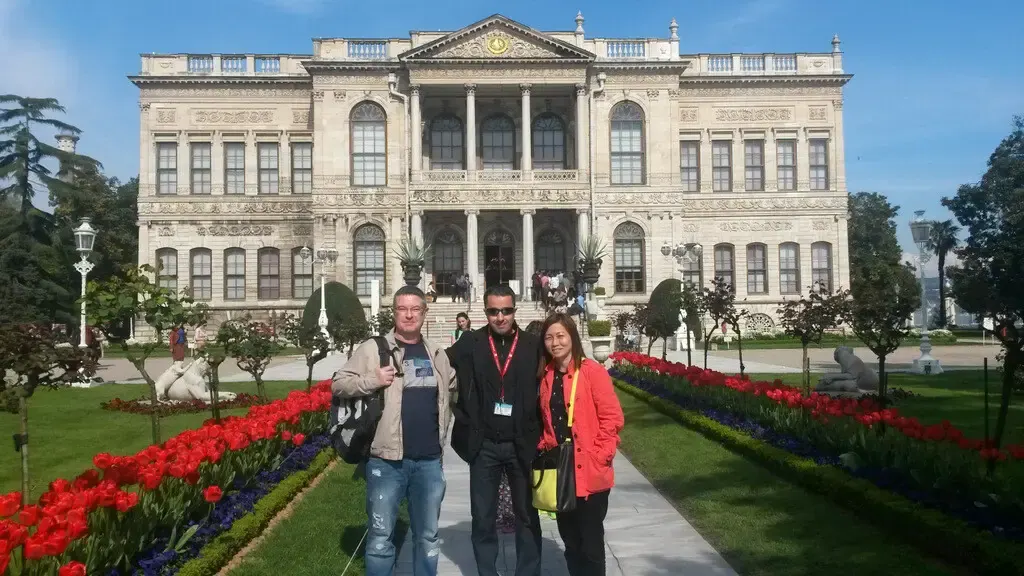
 من هولندا وفلاندرز
مرشد يتحدث الهولندية في إسطنبول: من يحتاجه وكيفية الحجز
يتوفر مرشد يتحدث الهولندية عند الطلب، حسب التوافر، ويُذكر السعر عند التأكيد. وتبدأ الجولات الخاصة المرشدة باللغة الإنجليزية من 199 دولارًا للمجموعة.
You can ask for a Dutch-speaking guide in Istanbul, but it is a request rather than a fixed product: we arrange it subject to availability and quote the price once a licensed guide who works in Dutch is confirmed for your dates. None of our tours lists Dutch as a standard language. If no Dutch-speaking guide is free, or if your group is happy in English, our private Istanbul tour with a licensed guide runs from $199 per group for an eight-hour day. This page is written for travellers from the Netherlands and Flanders: who in a Dutch-speaking group really benefits from a guide in their own language, which documents work at the Turkish border, how to fly in, and how to plan guided days that leave room for the independent exploring most Dutch and Belgian visitors enjoy.
How likely is a guide in Dutch?
Tourist guiding in Türkiye is a licensed profession, and every guide is registered for the languages they have been tested in. English, German, Russian, French, Spanish and Arabic are the big working languages in Istanbul. Dutch is a small one, so only a handful of guides can offer it, and they are booked first in the busy weeks of spring and autumn.
In practice that means three things:
- Ask early. Two to three months ahead gives you a real chance. In the May holidays and the autumn school break, when Dutch and Belgian families travel, ask even earlier.
- Be flexible on days. A guide may be free on Tuesday and Thursday but not Wednesday. If you can move one sightseeing day, the odds improve.
- Expect a clear yes or no. We send your dates to licensed guides who work in Dutch. If one confirms, you receive the guide's name, the plan and the price. If nobody is free, we say so straight away and offer a licensed English-speaking guide instead.
Nothing is charged for the Dutch-language part until a named guide has accepted. If you have seen a "Dutch tour" sold elsewhere without a guide's name attached, ask who the guide is before you pay.
Who in your group really needs Dutch
Most Dutch and Flemish adults follow an English-language tour without any trouble, so the question is less about the language than about who is in the group. This table is how we usually advise:
| Traveller | Dutch-speaking guide? | Why |
|---|---|---|
| Couples or friends who use English at work | Not needed | You will follow every detail in English, and you can book with much more freedom on dates |
| Grandparents or older relatives | Worth asking for | A long day of history in a second language is tiring, and questions come more easily in your own language |
| Children under about 12 | Worth asking for | Stories about sultans, cisterns and mosaics land better in the language they think in |
| Church, school or association groups | Strongly recommended | A group where English levels vary loses people quickly; one language keeps everyone together |
| Mixed families (Dutch and Turkish) | Often not needed | A Turkish relative often bridges the gap, and an English-speaking guide covers the rest |
A good compromise for many families is one day in Dutch for the dense history of Sultanahmet, and English for the easier days on the Bosphorus or in the markets. That also makes a Dutch-speaking guide easier to find, because you are asking for one date, not five.
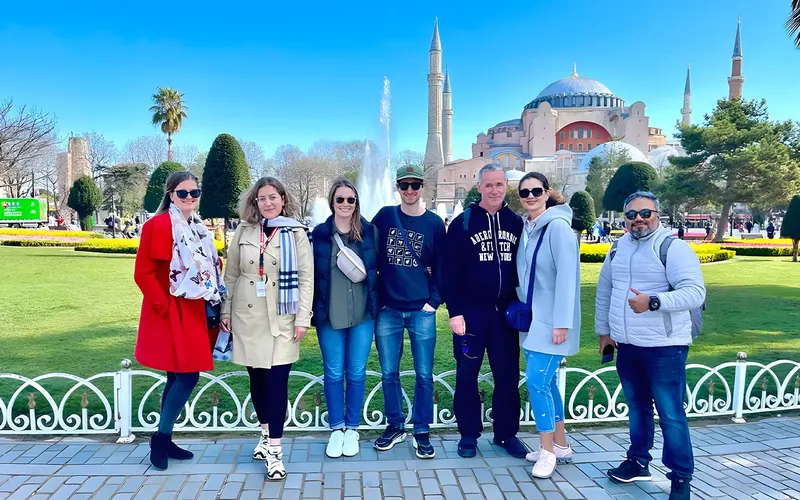
A Dutch or Belgian ID card is enough
The Turkish Ministry of Foreign Affairs lists both the Netherlands and Belgium among the 21 countries whose citizens may enter Türkiye with a national ID card. Visitors from both countries are visa-free for up to 90 days in any 180-day period, and there is no e-visa to buy and no entry fee.
Points that matter at the border:
- Validity. The Dutch government's travel information says your passport or ID card should be valid for at least 150 days when you arrive. Treat that as the rule for the whole family, and check children's documents, which run out sooner.
- Children travelling with one parent. Dutch guidance recommends carrying a consent letter signed by the other parent, with a copy of their ID.
- The whole route counts. An ID card works on a nonstop flight from Schiphol or Brussels. If you connect through a country outside the EU that does not accept it, you need a passport for that leg.
- Other nationalities in the group. A partner or friend with a non-EU passport may have different rules. Our Turkey visa requirements update covers them.
Surinamese, Aruban or other Dutch-speaking travellers without a Dutch or Belgian document should check their own passport's entry rules, as the ID-card list does not apply to them.
Flights from Schiphol, Brussels and regional airports
The flight is short enough for a long weekend. Nonstop flights from Amsterdam take roughly three and a half hours, and Brussels is similar. Turkish Airlines flies from both cities to Istanbul Airport (IST) on the European side, and low-cost carriers such as Pegasus and AJet fly to Sabiha Gökçen (SAW) on the Asian side, including from some regional Dutch airports. Our separate guide to an Istanbul city break from the Netherlands lists the routes airport by airport.
Türkiye stays on UTC+3 all year, so Istanbul is two hours ahead of Amsterdam and Brussels in winter and one hour ahead in summer.
Which airport you land at changes your first evening. From IST to Sultanahmet or Karaköy is usually 45 to 90 minutes by car depending on traffic; from SAW to the Old City it can take longer at rush hour. Our private airport transfer in a Mercedes Vito costs from $60 per group, and the Istanbul airport private transfer page explains the meeting point.
Guided days and free days: a plan that suits Dutch travellers
Dutch and Belgian visitors tend to like doing part of a city on their own: a ferry to Kadıköy, a walk along the Bosphorus, a long lunch with no schedule. Istanbul suits that well, because the ferry network is cheap and simple once someone has shown you how the Istanbulkart transport card works. We usually suggest guiding the parts of the city where a licensed guide adds the most, and leaving the rest free.
| Day | With a guide | On your own |
|---|---|---|
| 1 | Hagia Sophia, Blue Mosque, Hippodrome, Basilica Cistern | Evening in Sultanahmet or Karaköy |
| 2 | Topkapı Palace and the Harem, then the Grand Bazaar | Sunset ferry from Eminönü to Kadıköy |
| 3 | Free day | Balat, Fener and the Golden Horn on foot |
| 4 | Dolmabahçe Palace and a Bosphorus cruise | Bebek or Ortaköy for dinner |
Three closing days shape the plan. Topkapı Palace is closed on Tuesdays, Dolmabahçe Palace on Mondays and the Grand Bazaar on Sundays. Hagia Sophia and the Blue Mosque are working mosques, so visits pause around the Friday midday prayer. A guide who works in Dutch for the first two days, and English or no guide afterwards, is the pattern that works for most groups. For more structure, see our 4-day Istanbul itinerary.
Dinner is later than at home. Many Istanbul restaurants fill from about eight in the evening, so if your children eat at six, choose places near the hotel that serve all day.
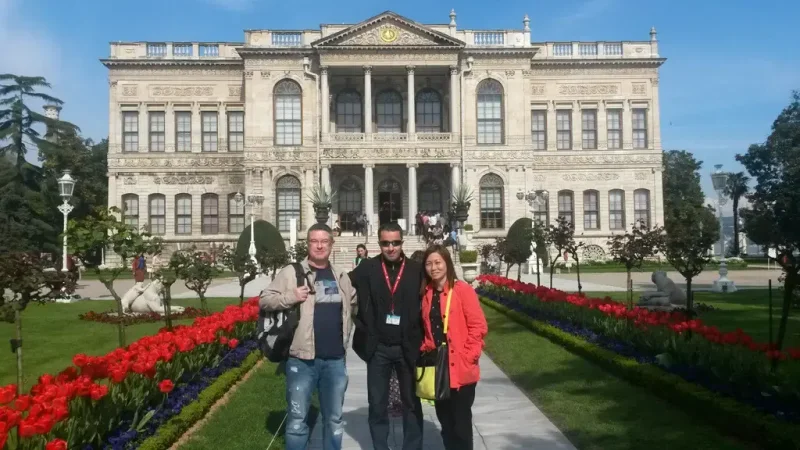
Tulips, a consulate and other Dutch links
A guide can make the city feel less foreign by starting from what you know. The tulip is the obvious one: the flower reached Western Europe from the Ottoman world in the sixteenth century, long before it became a Dutch export, and Istanbul still fills its parks with tulip beds each spring. If you travel in April, the beds at Emirgan Park and in front of Dolmabahçe Palace are in flower.
The Netherlands opened diplomatic relations with the Ottoman Empire in 1612. The Dutch consulate general still occupies the Palais de Hollande on İstiklal Avenue, close to Galata Tower, and the Union Church of Istanbul, a Protestant congregation with services in English, meets in the chapel in its garden. Ask your guide to walk you past on the way from Galata to Taksim.
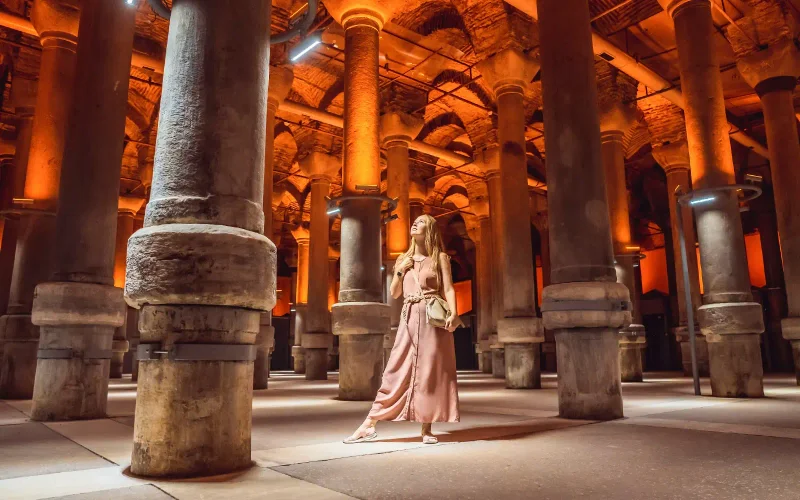
Children often remember other things best: the Medusa heads in the Basilica Cistern, the fact that Istanbul spans two continents, and the cats that sleep on every bench in Sultanahmet.
Money, phones and small details
- Currency. The Turkish lira. Cards and contactless payments work in most hotels, restaurants and shops in central Istanbul. At cash machines, decline the offer to charge you in euros and choose lira instead.
- Mobile data. Türkiye is outside EU roaming. Check your provider's Turkey rate or buy a local eSIM before you land.
- Plugs. The same two-pin sockets and 230 volts as in the Netherlands and Belgium.
- Mosque dress. Shoulders and knees covered for everyone, and a headscarf for women. Our guide on what to wear in Istanbul has seasonal advice.
- Tips. Leaving a tip in restaurants is normal in Türkiye; for guides and drivers it is appreciated, not compulsory.
- Museum tickets. Entrance fees for foreign visitors at several main monuments, including Hagia Sophia, are set in euros. See our Hagia Sophia ticket price update before you budget.
What a private guided day costs
Our published prices are for the tour itself. The Dutch-language option has no fixed price: it is quoted when a guide confirms.
- A full private day with a licensed guide is the most flexible format, priced per group, so it becomes cheap per person for a family of five or six.
- Fixed-route private tours are priced per person and suit couples.
- A car and driver can be added for older relatives who should not walk all day.
For a wider look at what guides charge across Türkiye, see how much a private tour guide costs and our overview of Istanbul tour prices.
Tours that cover this
- Best of Istanbul private guided tour, 1 to 3 days: from $199 per group per day, eight hours, built around your list of sights. The format we use when a Dutch-speaking guide is confirmed.
- Istanbul classic private guided tour: from $200 per person, the Old City highlights in six to eight hours.
- Dolmabahçe and Bosphorus tour with a private guide: from $150 per person, a good English-language day if you guide only part of your stay in Dutch.
- Private Mercedes Vito city tour with driver: from $299 per group for eight hours, for families with grandparents or small children.
If Istanbul is part of a longer trip, our tailor-made Turkey tour page explains how we plan routes to Cappadocia and the coast.
Frequently Asked Questions
Can I book a Dutch-speaking guide in Istanbul?
Yes, on request and subject to availability. Dutch is a small guiding language in Türkiye, so we check which licensed guides who work in Dutch are free on your dates and quote the price once one confirms. If nobody is available, we tell you straight away and offer a licensed English-speaking guide on the same plan.
How far ahead should I ask for a Dutch-speaking guide?
Ask two to three months before you travel if you can, and earlier for the May and autumn school holidays, when many Dutch and Belgian families go to Istanbul. Requests a week or two ahead sometimes work, but the chance is much lower. Flexible dates help, because the guide's free days decide the plan.
Can Dutch citizens enter Türkiye with an ID card?
Yes. The Turkish Ministry of Foreign Affairs lists the Netherlands among the countries whose citizens may enter with a national ID card, visa-free for up to 90 days in any 180-day period. The Dutch government advises that the card be valid for at least 150 days on arrival, so check every family member's document.
Can Belgians travel to Istanbul with their eID?
Yes, Belgium is also on the Turkish list of countries whose citizens may enter with a national ID card, and Belgians are visa-free for up to 90 days in 180. Check the card's validity well before travel, and carry a passport if your route connects through a country outside the EU that does not accept the card.
What is the time difference between Amsterdam and Istanbul?
Istanbul is two hours ahead of Amsterdam and Brussels in winter and one hour ahead in summer. Türkiye stays on UTC+3 all year and does not change its clocks, so the difference shrinks when the Netherlands and Belgium move to summer time at the end of March.
Is an English-speaking guide fine for Dutch travellers?
For most adults, yes. Dutch and Flemish visitors usually follow an English-language tour with ease, and English gives far more choice of guides and dates. A Dutch-speaking guide makes the biggest difference for grandparents, young children and groups where English levels vary, such as church or school groups.
How much does a private guide in Istanbul cost?
Our private guided day starts from $199 per group for eight hours, and fixed-route private tours start from $150 per person. These prices are for English-language tours; the Dutch-language option has no published price and is quoted when a guide confirms. Museum entrance fees are charged separately at the monuments unless a tour says otherwise.
Which days are Istanbul's main sights closed?
Topkapı Palace is closed on Tuesdays, Dolmabahçe Palace on Mondays and the Grand Bazaar on Sundays. Hagia Sophia and the Blue Mosque stay open daily but pause visits during prayer times, especially at midday on Fridays. A guide arranges the order of sights around these days so you do not arrive at a closed gate.
When are the tulips in flower in Istanbul?
April is tulip month in Istanbul. The city plants its parks with bulbs every year, and Emirgan Park on the Bosphorus and the gardens in front of Dolmabahçe Palace are the best places to see them. Exact flowering depends on the weather, so early to mid-April is usually the safest bet.
Sources: Republic of Türkiye Ministry of Foreign Affairs, visa information for foreigners and the list of countries whose citizens may enter Türkiye with national ID cards (mfa.gov.tr); NederlandWereldwijd, travel to Turkey with a passport or ID card (nederlandwereldwijd.nl); National Palaces Administration, weekly closing days for Topkapı and Dolmabahçe (millisaraylar.gov.tr); airline route information for Turkish Airlines, Pegasus and AJet — checked 6 November 2026.
جولات خاصة في إسطنبول
جولة خاصة في إسطنبول مع مرشد مرخّص: 1 أو 2 أو 3 أيام
احجز مرشدك المحلي المرخّص في إسطنبول ليوم أو يومين أو ثلاثة، واستكشف المدينة القديمة والقرن الذهبي ومضيق البوسفور بالوتيرة التي تناسب اهتماماتك.
نقل VIP من مطار إسطنبول: مرسيدس فيتو خاصة إلى فندقك
سيارة مرسيدس فيتو خاصة تنقلك من باب إلى باب من مطار إسطنبول إلى فندقك أو العكس، مع استقبال يحمل اسمك وتتبع مباشر للرحلة الجوية.
مرشدات ذات صلة
- عيد الفطر 2027 في إسطنبول من الإمارات: التواريخ وخطة العائلة
- زراعة الشعر في تركيا من المملكة المتحدة: الرحلات الجوية ونصائح الخدمة الصحية الوطنية والرعاية بعد العملية
- نقل من الفندق إلى مطار إسطنبول: متى تغادر وكيف تصل
- خدمة الاستقبال في مطار إسطنبول: كيف يعمل استلامك بلوحة الاسم
- ميني باص من مطار إسطنبول للعائلات والمجموعات: المقاعد والحقائب والسعر
- رحلة غداء في البوسفور من إسطنبول مع الاستقبال من الفندق: كيف تقارن
- رحلة إلى مدينة إسطنبول مع جولات إرشادية: خطة لمدة 5 أيام للناطقين بالألمانية
- رحلات إسطنبول: الرحلات العائلية والرحلات اليومية وأيام السفن السياحية
- خدمات الاستقبال والتشغيل في إسطنبول لمنظمي الرحلات: ما يديره الشريك المحلي
- نقل المجموعات في إسطنبول لـ17 شخصاً فأكثر: ميدي باص أو حافلة أو فانات
- مرشد سياحي في إسطنبول يتحدث العربية: أيام خاصة مع سائق
- مرشد سياحي في إسطنبول يتحدث الألمانية: جولات خاصة في المدينة باللغة الألمانية