

Tours & Experiences6 November 202614 min read
Byzantine vs Ottoman Istanbul: Which Sites to See and in What Order
From Constantine in 330 to the conquest of 1453 and the Bosphorus palaces: which Istanbul sites are Byzantine, which are Ottoman, and how to see both in the right order.
In this article
- Byzantine and Ottoman Istanbul in one timeline
- Byzantine Istanbul: the core sites in Sultanahmet
- Byzantine Istanbul beyond Sultanahmet
- Ottoman Istanbul: Topkapı and the imperial mosques
- Late Ottoman Istanbul: the Bosphorus palaces and fortresses
- Where the two empires overlap
- Which to prioritise: plans for one, two and three days
- Practical tips: closing days, prayer times and dress
- Tours that cover this
- Frequently Asked Questions
Byzantine Istanbul is the Christian imperial city of Constantinople, from its refounding by Constantine in 330 AD to the Ottoman conquest on 29 May 1453; Ottoman Istanbul is everything the sultans built over the next 470 years. Most first-time visitors see both in Sultanahmet without noticing where one ends and the other begins. This guide separates them: which sites belong to which empire, what is still open, which to prioritise if you have one, two or three days, and how to order your visits so the story makes sense. If you would rather follow one thread with a guide, our Byzantium relics half-day tour and Ottoman relics half-day tour are built exactly around this split.
The difference matters on the ground: Byzantine sites are older, often partly buried and spread out to the land walls, while Ottoman ones are mostly complete and still in use as mosques or palaces.
Byzantine and Ottoman Istanbul in one timeline
Istanbul has been a capital for roughly 1,600 years under two empires. The table gives the key dates and the buildings you can still see from each phase.
| Period | Dates | What happened | What you can see today |
|---|---|---|---|
| Greek Byzantion | 7th century BC to 330 AD | Greek colony on the tip of the peninsula; later a Roman city | Little above ground; finds in the Istanbul Archaeology Museums |
| Early Byzantine | 330 to 6th century | Constantine refounds the city as his capital in 330; Theodosius II builds the land walls in the 5th century; Justinian rebuilds after the Nika riots of 532 | Hippodrome, Theodosian Walls, Valens Aqueduct, Basilica Cistern, Hagia Irene, Little Hagia Sophia, Hagia Sophia (537) |
| Middle and late Byzantine | 7th century to 1453 | Iconoclasm, recovery, the Fourth Crusade sack of 1204, Byzantine return in 1261 | Mosaics in Hagia Sophia, Pantokrator (Zeyrek), Chora mosaics from the early 14th century |
| Early Ottoman | 1453 to about 1520 | Mehmed II conquers the city and makes it his capital | Rumeli Fortress (1452), Topkapı Palace (begun around 1459), Yedikule Fortress, Fatih Mosque area |
| Classical Ottoman | about 1520 to 1700 | Süleyman the Magnificent and the architect Mimar Sinan | Süleymaniye Mosque (1550-1557), Rüstem Pasha Mosque, Blue Mosque (1609-1616), Spice Bazaar (1664) |
| Late Ottoman | 1700 to 1922 | Westernised palaces move the court to the Bosphorus | Dolmabahçe Palace (completed 1856), Beylerbeyi Palace, Ortaköy Mosque |
In 1923 the new Republic of Türkiye made Ankara its capital, which ended Istanbul's 1,600 years as an imperial seat but left almost every building above in place.
Byzantine Istanbul: the core sites in Sultanahmet
Everything here is within a 15-minute walk, which makes Sultanahmet the natural first morning for anyone who comes for history.
Hagia Sophia. Justinian's great church was completed in 537 after the previous church burned in the Nika riots. For almost a thousand years it was the largest church in Christendom. Mehmed II converted it into a mosque in 1453, it became a museum in the 1930s, and it was turned back into a mosque in 2020. Today foreign visitors use a separate route to the upper galleries, where the best surviving mosaics are, including the Deësis panel, while the ground floor is kept for prayer. Foreign visitors pay a separate fee for this route; the details are in our Hagia Sophia ticket price update. Read the building first through its Byzantine eyes, then notice the Ottoman additions: the minarets, the mihrab and the giant calligraphic roundels. Our Hagia Sophia page has the full background.
Basilica Cistern. Across the road, this underground reservoir from Justinian's reign in the 6th century held water for the Great Palace. It is a forest of 336 columns, many of them reused from older buildings, including the two Medusa heads at the far end. It shows how much of Byzantine Istanbul sits below street level.
The Hippodrome. The long square in front of the Blue Mosque follows the line of the Byzantine chariot-racing track. Three monuments still stand on the old central barrier: the Egyptian obelisk of Thutmose III, set up here by Theodosius I in 390; the bronze Serpent Column, brought from Delphi; and the rough stone Walled Obelisk. This was the political centre of Constantinople, where emperors were cheered and riots began.
Hagia Irene. Inside the first courtyard of Topkapı Palace stands the other great Justinian church. Unusually, the Ottomans never turned it into a mosque. It served as an armoury instead, which is why its plain brick interior survived with its original atrium. Check whether your Topkapı ticket includes it before you queue.
Little Hagia Sophia. A short walk downhill, the former Church of Saints Sergius and Bacchus was built under Justinian in the 520s and 530s, a few years before Hagia Sophia, and became a mosque in the Ottoman period. It is quiet, free and often skipped.
One site you may read about is the Great Palace Mosaic Museum behind the Blue Mosque. It closed for restoration in 2023 and, as of November 2026, no reopening date had been announced, so do not build a plan around it.
Byzantine Istanbul beyond Sultanahmet
The second Byzantine layer is spread out to the west, near the old land walls. It takes a car or a long walk, which is why most group tours skip it.
Chora (Kariye Mosque). The former Chora Church in Edirnekapı holds some of the finest late Byzantine mosaics and frescoes anywhere, made in the early 14th century. It reopened as a mosque on 6 May 2024 after long restoration work. Foreign visitors pay an entrance fee, and access is restricted during prayers and on Fridays, so check before you go. The narthex mosaics showing the life of Christ and the Virgin are the reason to come. See our Chora page.
The Theodosian Walls. Built in the 5th century under Theodosius II, the triple line of land walls ran from the Sea of Marmara to the Golden Horn and kept the city safe for about a thousand years. They were finally breached in 1453. You can see restored stretches at Edirnekapı and Topkapı (the gate, not the palace), and at Yedikule, where the Ottomans later built a fortress around the old Golden Gate. Our Yedikule, Galata Tower and Balat tour covers that end of the walls.
Valens Aqueduct. The tall double-arched aqueduct across Atatürk Boulevard dates from the late 4th century and carried water into the city for centuries, later repaired by the Ottomans. You will drive under it on the way to Fatih and Chora.
Pantokrator (Zeyrek Mosque). A 12th-century monastery church complex of the Komnenos dynasty, later a mosque, on the hill above the Golden Horn. It is a working mosque, so visit outside prayer times.
Fener and Balat. The Greek Orthodox Patriarchate in Fener has been the seat of the Ecumenical Patriarch since the early 17th century, and nearby churches still hold services. This is the place where Byzantine Christianity continues as a living tradition rather than as a monument. Our Fener Greek Orthodox Patriarchate page and the Christian heritage tour of Istanbul cover it in detail.
Ottoman Istanbul: Topkapı and the imperial mosques
Mehmed II began Topkapı Palace around 1459 on the site of the old Byzantine acropolis, and it stayed the main residence of the sultans until the court moved to Dolmabahçe in 1856. The palace is not one building but a sequence of courtyards, each more private than the last: the public first court, the council hall of the second court, the treasury and relic rooms of the third, and the pavilions of the fourth looking over the Bosphorus. The Harem needs its own time. Topkapı is closed on Tuesdays. Our Topkapı Palace page explains the layout.
The mosques are the clearest Ottoman statement. Each sultan built a mosque complex (külliye) with schools, a hospital, a soup kitchen and a tomb, and placed it on a hilltop so the domes would dominate the skyline.
- Süleymaniye Mosque (1550-1557). Mimar Sinan's masterpiece for Süleyman the Magnificent, on the third hill. Its courtyard and the tombs of Süleyman and his wife Hürrem are as important as the prayer hall. The terrace behind it has one of the best views over the Golden Horn. See Süleymaniye Mosque.
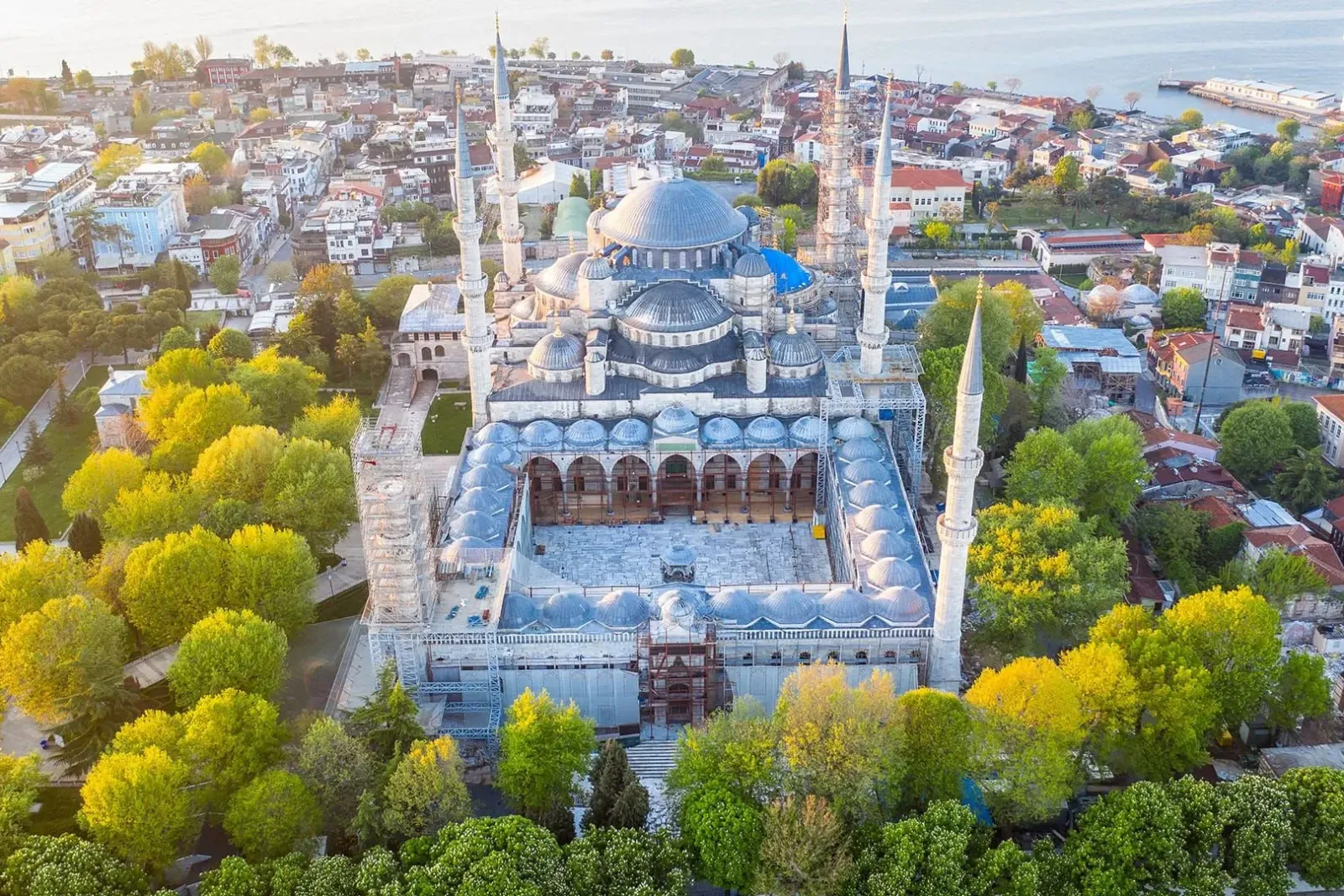
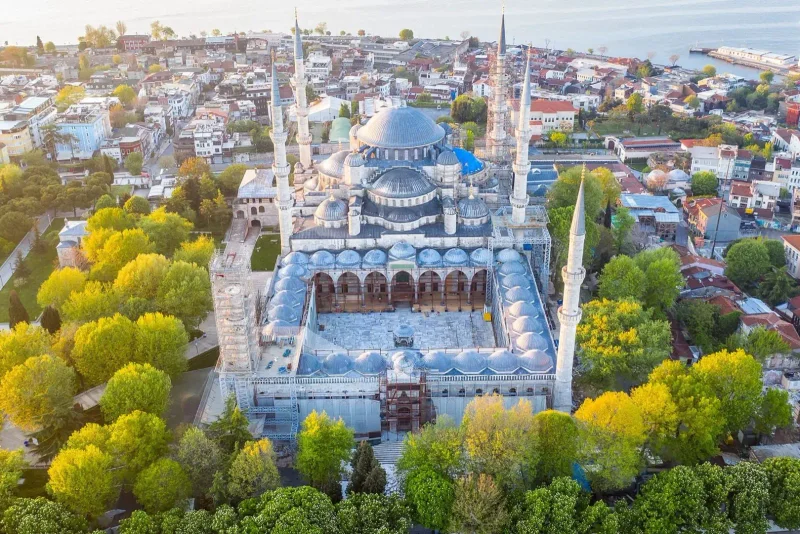
- Blue Mosque (1609-1616). Built by Sultan Ahmed I opposite Hagia Sophia, with six minarets and an interior lined with İznik tiles. It is still a working mosque and free to enter outside prayer times.
- Rüstem Pasha Mosque. A small Sinan mosque above the shops near the Spice Bazaar, built for Süleyman's grand vizier in the early 1560s. It has the finest İznik tilework in the city at close range.
If you want to see how these buildings relate to Hagia Sophia, stand in the Hippodrome and look both ways: Ottoman architects spent a century trying to match and surpass Justinian's dome, and the Blue Mosque was placed deliberately to face it. Our Istanbul mosques tour page covers etiquette and the best order of visits.
Late Ottoman Istanbul: the Bosphorus palaces and fortresses
The Ottoman story does not end in the old city. Two buildings frame the empire on the Bosphorus.
Rumeli Fortress (1452). Mehmed II built this fortress on the European shore in a matter of months before the siege, to control the strait and cut off help from the Black Sea. It is the opening chapter of Ottoman Istanbul, built a year before the conquest.
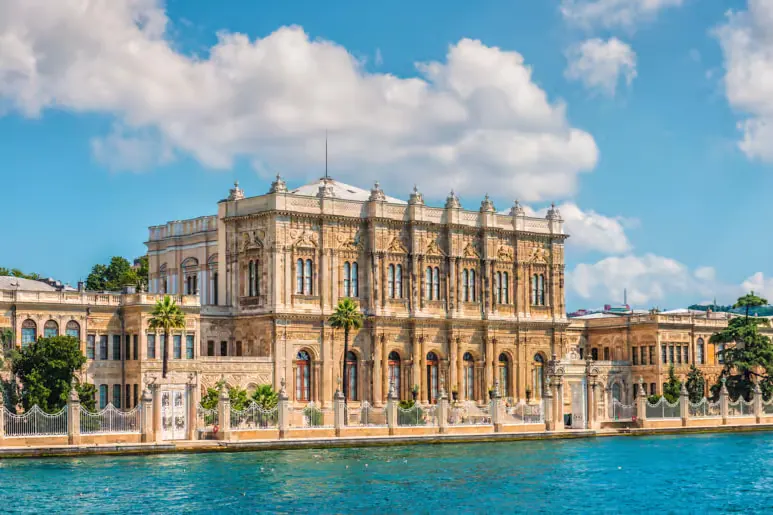
Dolmabahçe Palace (completed 1856). By the 19th century the sultans wanted a European-style palace, and Dolmabahçe replaced Topkapı as the main residence. Its crystal staircase and the huge ceremonial hall show an empire trying to modernise. Mustafa Kemal Atatürk died here in 1938, and the clocks in his room are kept at 9:05. Dolmabahçe is closed on Mondays.
Beylerbeyi Palace. The summer palace on the Asian shore, built in the 1860s, is smaller and easier to visit than Dolmabahçe. Our Beylerbeyi Palace and Çamlıca Hill tour pairs it with the view from the Asian side.
Where the two empires overlap
The most interesting places in Istanbul are the ones where Byzantine and Ottoman layers share the same building. The Ottomans rarely destroyed the great churches. They converted them, added minarets and a mihrab, plastered over figurative mosaics in some cases, and kept using the structures. That is why Hagia Sophia, Little Hagia Sophia, Chora and Zeyrek all survive.
Other overlaps are less obvious. Topkapı sits on the Byzantine acropolis, and Hagia Irene stands in its first courtyard. Yedikule Fortress wraps Ottoman towers around the Byzantine Golden Gate. The Grand Bazaar grew around a 15th-century Ottoman core, close to the old Forum of Constantine, where the battered Column of Constantine still stands by Çemberlitaş tram stop.
A good way to see the overlap is to visit Hagia Sophia and the Süleymaniye on the same day. One is the building Ottoman architects studied; the other is their answer.
Which to prioritise: plans for one, two and three days
You do not need a week to see both empires, but you do need to choose. The table shows what fits.
| Time you have | Byzantine focus | Ottoman focus | Best combined plan |
|---|---|---|---|
| Half a day | Hagia Sophia, Basilica Cistern, Hippodrome | Blue Mosque, Topkapı (not Tuesday) | Hagia Sophia, Hippodrome, Blue Mosque |
| One day | Add Little Hagia Sophia and Hagia Irene | Add the Harem and Süleymaniye | Morning: Hagia Sophia and Cistern. Afternoon: Topkapı, then Süleymaniye at sunset |
| Two days | Day 2: Chora, Theodosian Walls, Fener and Balat | Day 2: Rüstem Pasha, Spice Bazaar, Dolmabahçe (not Monday) | Day 1 as above. Day 2: Chora, walls and Balat in the morning, Dolmabahçe or a Bosphorus cruise in the afternoon |
| Three days | Day 3: Archaeology Museums, Zeyrek, Yedikule | Day 3: Rumeli Fortress, Beylerbeyi, Eyüp | Day 3: Archaeology Museums, then the Bosphorus palaces and fortress |
If you are a history lover with only one day, the combined plan gives you the most continuous story: the Byzantine core in the morning, Ottoman power in the afternoon, and the skyline of domes at the end. For longer stays, see our 3-day Istanbul itinerary for a full day-by-day plan that includes food and the Bosphorus.
Practical tips: closing days, prayer times and dress
- Closing days. Topkapı Palace closes on Tuesdays and Dolmabahçe on Mondays. Plan the two palaces on different days, and avoid putting Topkapı on a Tuesday.
- Prayer times. Working mosques, including Hagia Sophia, the Blue Mosque, Süleymaniye, Chora and Rüstem Pasha, close to visitors for a period around each of the five daily prayers, and for longer at midday on Friday. Mornings before the midday prayer are the easiest time.
- Dress. For all mosques, shoulders and knees should be covered, and women need a headscarf. Our what to wear in Istanbul guide covers it in detail.
- Tickets. Museum fees for foreign visitors are set in euros or lira and change, usually at the start of the year. Hagia Sophia, Topkapı, Chora and the Basilica Cistern each have separate tickets, so budget for several.
- Walking. The historic peninsula is hilly. The Byzantine sites in the west, around Chora and the walls, are far from the tram, so a car or taxi saves hours.
If you would like someone else to handle the order and tickets, a private guide can join both halves of the story in a single day. Our sister site private Istanbul tours also runs guided days in the old city.
Tours that cover this
- Half-Day Istanbul Tour: Byzantium Relics — from $67 per person. The Byzantine core in one morning.
- Half-Day Istanbul Tour: Ottoman Relics — from $88 per person. The Ottoman mosques and palace in one session.
- Istanbul History Tour — from $161 per person, for both empires with a licensed guide.
- Istanbul Active Churches Tour with Private Guide — 7 hours, from $180 per person, focused on the Christian heritage of Fener, Balat and beyond.
For more options see all our Istanbul tours and the Istanbul destination guide.
Frequently Asked Questions
What is the difference between Byzantine and Ottoman Istanbul?
Byzantine Istanbul is the Christian city of Constantinople, capital of the Eastern Roman Empire from 330 AD to 1453. Ottoman Istanbul is the Muslim imperial capital the sultans built after the conquest of 29 May 1453 until the empire ended in 1922. Byzantine sites are mostly churches, cisterns and walls; Ottoman sites are mosques, palaces and bazaars.
Is Hagia Sophia Byzantine or Ottoman?
Hagia Sophia is a Byzantine building, completed in 537 under Emperor Justinian as a church. The Ottomans converted it into a mosque in 1453 and added the minarets, mihrab and large calligraphy panels. So the structure and mosaics are Byzantine, while many of the fittings you see inside are Ottoman. It has been a working mosque again since 2020.
Is the Blue Mosque Byzantine?
No. The Blue Mosque is fully Ottoman, built between 1609 and 1616 for Sultan Ahmed I. It stands on land that was once part of the Byzantine Great Palace, facing Hagia Sophia across the old Hippodrome, which is why the two are often confused. Its six minarets and İznik tiles are classic Ottoman features.
What is the best Byzantine site in Istanbul after Hagia Sophia?
The Chora (Kariye Mosque) in Edirnekapı has some of the finest late Byzantine mosaics and frescoes anywhere, from the early 14th century. It reopened as a mosque in May 2024 and foreign visitors pay an entrance fee. The Basilica Cistern is the easiest second choice, as it is opposite Hagia Sophia, while Chora needs a car or taxi.
How many days do I need for historic Istanbul?
Two full days cover the main Byzantine and Ottoman sites comfortably: one day in Sultanahmet for Hagia Sophia, the Cistern, the Hippodrome, Topkapı and the Süleymaniye, and a second for Chora, the land walls, Fener, Balat and Dolmabahçe. A third day adds the Archaeology Museums and the Bosphorus palaces. One day is enough only for the highlights.
Which day is Topkapı Palace closed?
Topkapı Palace is closed on Tuesdays. Dolmabahçe Palace, the later Ottoman palace on the Bosphorus, is closed on Mondays. If you want to see both palaces, put them on different days and avoid those two closures. Mosques do not have a weekly closing day, but they close to visitors during prayers.
Can you still see Byzantine mosaics in Istanbul?
Yes. The upper galleries of Hagia Sophia hold the Deësis panel and imperial portraits, and the Chora has complete narrative cycles of mosaics and frescoes from the 14th century. Some mosaics in working mosques are covered during prayer. The Great Palace Mosaic Museum has been closed for restoration since 2023, with no reopening date announced as of November 2026.
What happened on 29 May 1453?
On 29 May 1453 the Ottoman army of Sultan Mehmed II took Constantinople after a siege of about seven weeks, ending the Byzantine Empire. The last emperor, Constantine XI, died in the fighting. Mehmed made the city his capital, converted Hagia Sophia into a mosque, and began rebuilding and repopulating the city, starting the Ottoman period that lasted until 1922.
Do I need a guide to understand historic Istanbul?
You can visit every site on your own, but a licensed guide makes the layers readable, especially in Hagia Sophia, Topkapı and Chora, where little is labelled. A guide also plans around closing days and prayer times. If you go alone, read up on each building first and visit the Byzantine sites before the Ottoman ones so the story runs in order.
Sources: Encyclopaedia Britannica on Hagia Sophia and Constantinople; The Metropolitan Museum of Art (metmuseum.org) essay "Hagia Sophia, 532-37"; Reuters on the July 2020 court ruling on Hagia Sophia; Turkish press and the Directorate General of Foundations on the Kariye (Chora) Mosque reopening of 6 May 2024; published visitor information on Topkapı and Dolmabahçe closing days and on the Great Palace Mosaic Museum restoration — checked 6 November 2026.
Written by the Get Turkey Tours team: licensed local guides and trip planners based in Istanbul.
Leave a Comment
Our private tours
Istanbul Half-Day Morning Tour: Hagia Sophia, Blue Mosque & Bazaar
A guided 4-hour morning walk through Sultanahmet covering the Hippodrome, Blue Mosque, Hagia Sophia and Grand Bazaar, finishing around 12:30 so your afternoon stays free.
Topkapi Palace Afternoon Tour in Istanbul with Harem & Treasury
A four-hour guided afternoon from 13:00 at Topkapi Palace, covering the Sultans' Tombs, Imperial Courtyards, Harem, Treasury and Islamic Relics, with palace and Harem entry included.
Related articles
 Tours & Experiences
Whirling Dervish Ceremony in Istanbul: Where to See It, Times, Prices
Where to see a real sema in Istanbul: Hodjapasha's nightly ceremony and the Kasımpaşa Mevlevi Lodge, times and prices, the Galata lodge museum, what each part means, etiquette and Konya's Şeb-i Arus.
Read More Tours & Experiences
What to Eat in Cappadocia: Testi Kebab, Mantı and Where to Try Them
Testi kebab, Kayseri mantı, pastırma, clay-pot home cooking, kuru kaymak and Emir wine: what to eat in Cappadocia, how the registered recipes work, where to eat and which tours include meals.
Read More Tours & Experiences
Cappadocia Photo Spots: Where to Shoot and When, Sunrise to Sunset
Where and when to photograph Cappadocia: balloon viewpoints at first light, Love Valley, Uçhisar, Paşabağ and Red Valley at sunset, monthly light times, rooftop etiquette and the 2026 drone rules.
Read More