

Reisetips19. november 202614 min lesetid
Den store basaren vs kryddebasaren: hvilken du bør besøke, hva du bør kjøpe, åpningstider
Hvordan Istanbuls to historiske markeder skiller seg i alder, størrelse og hva de selger, hvilket som åpner på søndager, Eid-stengningene 2027, prutting, og hvordan se begge på én dag.
I denne artikkelen
- Grand Bazaar vs Spice Bazaar at a glance
- Two markets, two jobs: a short history
- What to buy where
- Opening days: Sundays and the 2027 Eid closures
- Prices and bargaining in each
- How long each takes, and the best time of day
- Doing both in one day: the walk and the tours
- Only time for one? How to choose
- Tours that cover this
- Frequently Asked Questions
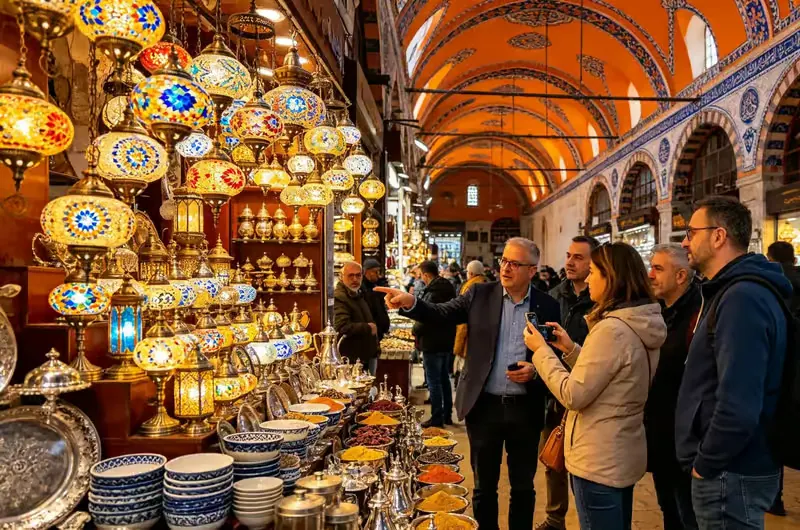
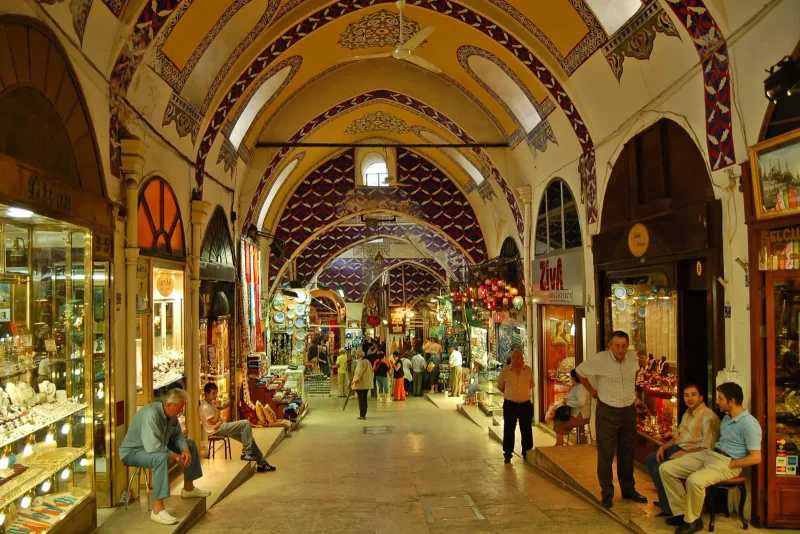
The Grand Bazaar and the Spice Bazaar are Istanbul's two great historic markets, and they do different jobs. The Grand Bazaar (Kapalıçarşı), founded in 1461, is a covered market of some 3,600 shops on 65 streets selling carpets, jewellery, leather, textiles and ceramics. The Spice Bazaar (Mısır Çarşısı), finished in 1664, is a single vaulted hall at Eminönü for spices, Turkish delight, nuts, dried fruit and tea. Go to the Grand Bazaar to shop and the Spice Bazaar to taste; on a Sunday, only the Spice Bazaar is open. Both are free to enter and close enough to see in one day, and our private shopping tour of the Grand Bazaar and Spice Market covers both with a licensed guide, from $90 per person.
Grand Bazaar vs Spice Bazaar at a glance
| Grand Bazaar (Kapalıçarşı) | Spice Bazaar (Mısır Çarşısı) | |
|---|---|---|
| Built | 1461 is its accepted founding year, under Sultan Mehmed II | Begun in 1660 and finished in 1664 as the market of the New Mosque |
| Size | 65 streets, about 3,600 shops and 14 hans, according to its traders' association | One long vaulted hall with six gates; no official shop count |
| Best for | Carpets and kilims, gold and silver jewellery, leather, textiles, ceramics, lamps, antiques | Spices, Turkish delight, nuts, dried fruit, herbal teas |
| Open | Monday to Saturday | Every day |
| Sundays | Closed | Open |
| 2027 Eid holidays | Closed on 9 to 11 March and 16 to 19 May | Also listed as closed for both Eids |
| Hours | 08:30 to 19:00 on the ministry's culture portal; roughly 09:00 to 19:00 in October 2026 | Roughly 09:00 to 19:00 in October 2026 |
| Entry | Free | Free |
| Time to allow | 1 to 2 hours to browse, longer to buy | About 45 minutes, or up to 1½ hours with the streets outside |
| Bargaining | Expected in most shops, but not at jewellers selling gold by weight | Prices usually on signs, per kilo; taste, then buy by the 100 or 250 g |
| Our nearest tour | Half-day Old City tour, which ends inside it, from $67 | Morning Bosphorus cruise, which starts there, from $40 |
Our Grand Bazaar and Spice Bazaar guides cover each market on its own.
Two markets, two jobs: a short history
The Grand Bazaar was built to earn money for Hagia Sophia. Under the Ottoman foundation system, a mosque's upkeep was paid for by buildings that earned rent, and the Grand Bazaar Traders' Association (Kapalıçarşı Esnafları Derneği) says Mehmed II had the Cevahir and Sandal bedestens, strong halls where valuables were kept and traded, built to bring in income for Hagia Sophia. The association and the Ministry of Culture and Tourism both give 1461 as the founding year, and the association says the bazaar grew around those halls over some 250 years. It once served as a bank and financial centre, the ministry's culture portal notes, and the association says it is still an important centre for gold and currency prices in Turkey. Writing in the 1640s, the traveller Evliya Çelebi described a fearsome bird with outspread wings over the jewellers' gate, and explained it: profit is a wild bird, and if you can hunt it with courtesy, you will make your gain in this bedesten.
How big is it? The association's history page gives 3,600 shops and 14 hans on 65 streets, spread over 110,868 m², of which 45,000 m² is covered; the ministry also gives 3,600 shops. The association's own figures page counts differently: 2,486 shops, 62 streets and 18 hans, with 30,000 people at work and 44 million visitors a year. Treat any shop count as approximate.
The Spice Bazaar came two centuries later, for the same reason. It was the market (arasta) of the New Mosque complex at Eminönü, and its rents paid for the mosque. Work began in 1660 on the orders of Turhan Sultan, mother of Sultan Mehmed IV, under the chief court architect Kâzım Ağa, and another chief court architect, Mustafa Ağa, completed it in 1664, the ministry's culture portal records. It was built with taxes from Egypt, and most of what it sold, spices included, came from there, so from the middle of the 18th century it became known as Mısır Çarşısı, the Egyptian Bazaar.
It was first let to herbalists and cotton merchants, and the rooms above its two main gates housed commercial courts for the traders' disputes. The building has been through two great fires, was restored in 1940–1943 and again in 2015–2018, and was separated from the New Mosque in 1941, when a road was cut through the mosque's courtyard.
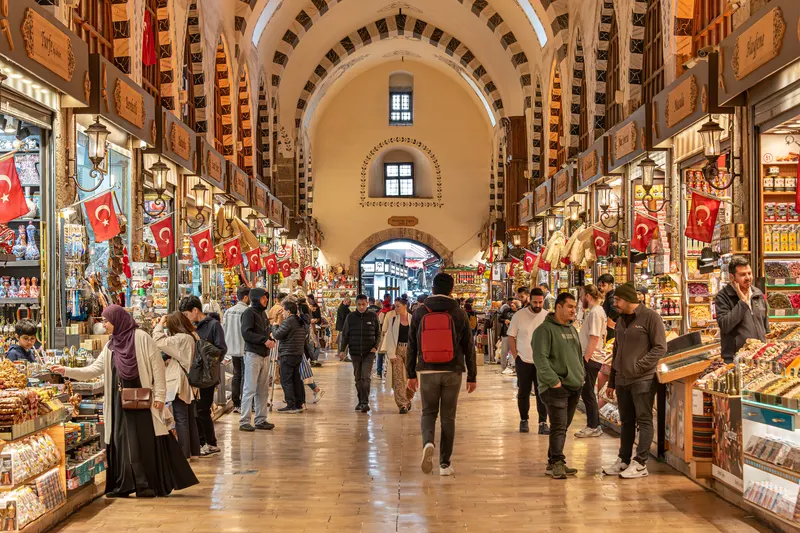
Photo: Jorge Franganillo, CC BY 4.0, via Wikimedia Commons
What to buy where
The simplest rule: the Grand Bazaar for things you keep, the Spice Bazaar for things you eat. The ministry's culture portal lists carpets, bags, textiles, gold and silver jewellery, antiques, tiles and souvenirs at the Grand Bazaar, and mostly spices and Turkish delight, with some jewellers and souvenir shops, at the Spice Bazaar.
In the Grand Bazaar
- Jewellery: Kalpakçılar Caddesi, the main street between the Beyazıt and Nuruosmaniye gates, is lined with jewellers.
- Antiques, silver, old coins and copper: the Old Bedesten at the centre, calmer than the main lanes.
- Carpets, kilims, textiles, leather, lamps and ceramics: quality runs from museum standard to mass-produced imports, sometimes in neighbouring shops, which is where a guide earns their fee.
In the Spice Bazaar
- Spices: sumac, pul biber chilli flakes, isot pepper, cumin and saffron; ask for vacuum packing if you are flying.
- Turkish delight (lokum): dozens of flavours, with pistachio and plain rose the classics.
- Nuts and dried fruit: Antep pistachios, Malatya apricots, figs and mulberries.
- Tea: apple tea is sold mainly to visitors, while Turks drink black tea from Rize; our guide to Turkish coffee and tea in Istanbul explains how locals order both.
- Outside the hall: on Hasırcılar Caddesi, to the west, shops sell cheese and olives, and a coffee roaster draws a queue of locals.
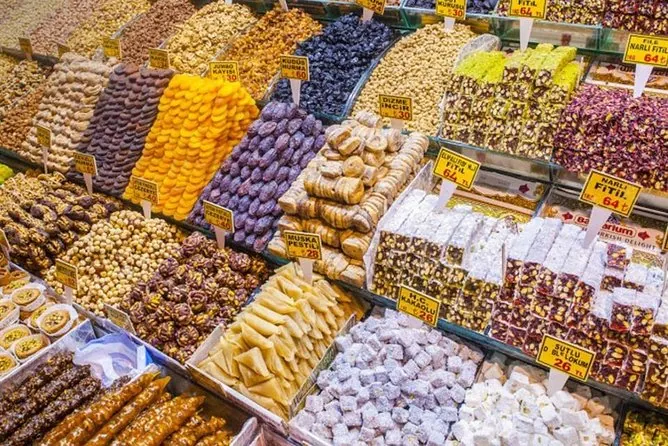
Before you buy food to take home, check your own country's customs rules: some, including Australia, New Zealand and the United States, restrict certain spices and seeds. To eat your way through these streets, see our private Istanbul food tour.
Opening days: Sundays and the 2027 Eid closures
Sundays. The ministry's culture portal lists the Grand Bazaar as open every day except Sundays and religious holidays, from 08:30 to 19:00, and our Grand Bazaar guide puts the practical hours, as of October 2026, at roughly 09:00 to 19:00, with some shops closing from 18:30. The Spice Bazaar opens every day, Sundays included, from roughly 09:00 to 19:00 (October 2026).
So on a Sunday, plan the Spice Bazaar and the water. Our morning Bosphorus cruise with a Spice Bazaar stop runs daily, from $40 per person, and our private Old City tour, from $200 per person with museum tickets extra, visits the Spice Market instead of the Grand Bazaar on Sundays; the private shopping tour does not run that day. More ideas: what to do in Istanbul on a Sunday.
The 2027 Eid holidays. According to the Presidency of Religious Affairs (Diyanet), Eid al-Fitr (Ramazan Bayramı) falls on Tuesday 9 to Thursday 11 March 2027, with a half-day public holiday on the eve, Monday 8 March, and Eid al-Adha (Kurban Bayramı) on Sunday 16 to Wednesday 19 May, with a half-day on Saturday 15 May. As the ministry lists the Grand Bazaar as closed on religious holidays, plan on no Grand Bazaar shopping on 9 to 11 March or 16 to 19 May. Our Spice Bazaar guide lists both Eids as closing days too, so shop before the festival; our 2027 public holidays update shows what else closes.
Prices and bargaining in each
Grand Bazaar: bargain, but know your number. Haggling is expected almost everywhere, except at jewellers who sell gold by weight and a few fixed-price shops. Compare before you buy, offer a figure you would be happy to pay, and be ready to walk away. Cash often gets a lower price than a card, and tea offered in a carpet shop is hospitality, not an obligation. For a big purchase, ask for an invoice, and for a carpet, a certificate of origin; if the shop ships it home, get the shipping cost in writing first.
Spice Bazaar: taste, weigh, pay. Signs usually show the price per kilo, and asking for 100 or 250 grams is normal. Tasting is expected, and you do not have to buy afterwards. Many shops take cards, though cash may earn a small discount. Inside the hall, prices run higher than in the shops on Hasırcılar Caddesi just outside, which sell the same pistachios and spices.
In both: be wary of anyone who stops you in the street to take you to "a friend's shop"; the commission ends up in your price. Our page on Istanbul tourist scams to avoid explains the common ones. Tax-free refunds and the rules for taking older carpets out of the country are on our Istanbul shopping tour page, and other markets are in Istanbul shopping beyond the Grand Bazaar.
How long each takes, and the best time of day
Grand Bazaar: one to two hours to browse, longer if you are buying seriously. Weekday mornings from 09:00 to 11:00 are the quietest; Saturdays fill with local shoppers, and traders start packing away from about 18:30.
Spice Bazaar: about 45 minutes, or up to an hour and a half with the streets around it. A weekday morning is easiest. Local families fill the hall on Saturdays and Sunday afternoons, ferry commuters crowd the outer streets in the late afternoon, and the busiest days come just before the holidays, when people buy nuts and sweets in bulk, so expect crowds in the days before 9 March and 16 May 2027.
Doing both in one day: the walk and the tours
The two bazaars are close enough to walk between. Leave the Grand Bazaar on its Mahmutpaşa side and follow the market streets downhill to Eminönü, where the Spice Bazaar stands beside the New Mosque and the Galata Bridge. Both are also on the T1 tram: the Beyazıt–Kapalıçarşı stop for the Grand Bazaar, Eminönü for the Spice Bazaar.
A good order, Monday to Saturday:
- The Grand Bazaar at opening, when the lanes are quietest, entering by the Nuruosmaniye Gate, which faces Sultanahmet, or the Beyazıt Gate by the tram.
- Lunch, then downhill through the Mahmutpaşa market streets.
- The Spice Bazaar in the early afternoon, with Sinan's Rüstem Pasha Mosque and its Iznik tiles up a staircase from the market street.
- Finish on the water at Eminönü, with a ferry from our Bosphorus cruise today list or a walk across the Galata Bridge.
With a guide. The tour built for both bazaars is our private shopping tour: about six hours with your own licensed guide, Monday to Saturday, from $90 per person; a private van is optional and not in the price. Two group tours also pair well with a walk:
- Sultanahmet in the morning, the Spice Bazaar after lunch. The half-day Old City tour visits the Hippodrome, the Blue Mosque and Hagia Sophia and ends inside the Grand Bazaar at around 12:30, from $67 per person; it does not run on Fridays.
- The Spice Bazaar and the Bosphorus in the morning, the Grand Bazaar after lunch. The morning Bosphorus cruise starts at the Spice Bazaar and drops you in Sultanahmet around midday, from $40 per person, a short walk from the Nuruosmaniye Gate.

Only time for one? How to choose
- You want something to keep, such as a carpet, jewellery, leather or ceramics: the Grand Bazaar.
- You want food gifts, such as spices, Turkish delight, nuts or tea: the Spice Bazaar.
- It is a Sunday: the Spice Bazaar, because the Grand Bazaar is closed.
- You have under an hour, or a ferry to catch at Eminönü: the compact Spice Bazaar, by the piers.
- It is raining or very hot: the Grand Bazaar, under its roof.
- You want to see how the city trades, not only shop: the Grand Bazaar, for the hans and workshops described on our Grand Bazaar tour page.
- It is 9 to 11 March or 16 to 19 May 2027: neither, without checking first.
For a guide of your own, see our Istanbul private tour guide page.
Tours that cover this
- Private Istanbul Shopping Tour: Grand Bazaar and Spice Market Guide: from $90 per person. About six hours with your own licensed guide, from and back to your hotel, with drink samples; meals and the optional van are extra. Monday to Saturday.
- Morning Bosphorus Cruise Tour in Istanbul with Spice Bazaar Stop: from $40 per person. Daily group tour: 08:30 pick-up from central hotels, the Spice Bazaar, a guided cruise, drop-off in Sultanahmet.
- Istanbul Half-Day Morning Tour: Hagia Sophia, Blue Mosque & Bazaar: from $67 per person. Group tour, 08:30 to about 12:30, with an English-speaking licensed guide, ending inside the Grand Bazaar; not on Fridays.
- Full-Day Bosphorus Cruise & Two Continents Tour in Istanbul: from $88 per person. Group tour, 08:30 to about 17:00: the Spice Bazaar, a cruise, lunch, Beylerbeyi Palace with entry, and Çamlıca Hill. Ask us which days it runs.
The Hagia Sophia small-group tour with the Blue Mosque and the bazaar, from $120 per person with entry tickets included, ends with free time in the Grand Bazaar. Every option is on our Istanbul tours page.
Send us your dates on WhatsApp (+90 545 307 67 88), with the day of the week you have for the bazaars and what you hope to buy, and we will reply in writing with the private shopping tour or the option that fits your day.
Frequently Asked Questions
Which is better, the Grand Bazaar or the Spice Bazaar?
It depends on what you want. The Grand Bazaar is better for shopping and for a historic market at full scale: carpets, jewellery, leather and ceramics on some 65 streets. The Spice Bazaar is better for food gifts and a visit of about 45 minutes. With a free weekday or Saturday, see both.
Is the Grand Bazaar open on Sunday?
No. The Grand Bazaar closes every Sunday and on religious holidays. From Monday to Saturday the ministry's culture portal lists it as open from 08:30 to 19:00, and in practice most shops trade from about 09:00. On a Sunday, go to the Spice Bazaar, which opens every day.
How far is the Grand Bazaar from the Spice Bazaar?
Close enough to walk between in the same morning. From the Grand Bazaar's Mahmutpaşa side, the old market streets run downhill to Eminönü, where the Spice Bazaar stands beside the New Mosque. Both are also stops on the T1 tram: Beyazıt–Kapalıçarşı for the Grand Bazaar and Eminönü for the Spice Bazaar.
Are the bazaars open during Eid in 2027?
Plan on them being closed. The ministry lists the Grand Bazaar as closed on religious holidays, and in 2027 Eid al-Fitr falls on 9 to 11 March and Eid al-Adha on 16 to 19 May, according to Diyanet. Our Spice Bazaar guide lists both Eids as closing days too, so shop in the days before.
What should I buy at the Grand Bazaar?
Things you will keep: carpets and kilims, gold and silver jewellery, leather, textiles, ceramics and lamps, plus antiques and old coins in the Old Bedesten at its centre. Quality varies between neighbouring shops, so compare first, and ask for an invoice on a big purchase and a certificate of origin for a carpet.
What should I buy at the Spice Bazaar?
Food gifts that travel well: spices such as sumac, pul biber and saffron, Turkish delight, pistachios, dried apricots and figs, and tea. Taste first, buy 100 or 250 grams at a time and ask for vacuum packing if you are flying. Some countries restrict certain spices and seeds, so check your customs rules.
Do you have to bargain at the Spice Bazaar?
There is less need than in the Grand Bazaar, because prices are usually marked on signs, per kilo, and you simply ask for the weight you want. Tasting does not oblige you to buy. Cash may earn a small discount, and the shops on Hasırcılar Caddesi just outside usually charge less than those inside for the same nuts and spices.
How many shops are in the Grand Bazaar?
About 3,600 on 65 streets, with 14 hans, according to the history page of the Grand Bazaar Traders' Association, a figure the ministry also gives. The association's own figures page counts 2,486 shops, 62 streets and 18 hans, so treat the number as approximate.
Can I visit the Grand Bazaar and the Spice Bazaar in one day?
Yes, from Monday to Saturday. Start at the Grand Bazaar in the morning, when it is quietest, then walk downhill through the Mahmutpaşa streets to the Spice Bazaar. Our private shopping tour covers both with a licensed guide in about six hours, from $90 per person, and does not run on Sundays.
Sources: Grand Bazaar Traders' Association (Kapalıçarşı Esnafları Derneği), pages "Kapalı Çarşı hakkında" and "Sayılarla Kapalı Çarşı" (kapalicarsi.com.tr); Republic of Türkiye Ministry of Culture and Tourism, Kültür Portalı pages on Kapalıçarşı and Mısır Çarşısı (kulturportali.gov.tr); Presidency of Religious Affairs (Diyanet), 2027 official holidays (vakithesaplama.diyanet.gov.tr); Get Turkey Tours attraction guides for the Grand Bazaar and the Spice Bazaar, and tour pages — checked 19 November 2026.
Skrevet av Get Turkey Tours-teamet: lisensierte lokale guider og reiseplanleggere med base i Istanbul.
Legg igjen en kommentar
Våre private turer
Privat shoppingtur i Istanbul: Guide til Den store basaren og krydderbazaren
En privat shoppingtur gjennom Krydderbazaaren og Den store bazaren, ledet av en lokal guide som kjenner til ærlige handelsmenn og rimelige priser.
Istanbul halvdagstur om morgenen: Hagia Sophia, Den blå moskeen og basaren
En guidet 4-timers morgentur gjennom Sultanahmet med hippodromen, Den blå moskeen, Hagia Sophia og Den store basaren, og den avsluttes rundt kl. 12:30, slik at ettermiddagen forblir fri.
Relaterte artikler
 Reisetips
Istanbul or Cappadocia: Which to Choose, Which First, How Many Days
Only time for one? Istanbul suits history and city lovers, Cappadocia balloons and valley walks. How to choose, which to see first, and how five or six days covers both from $840.
Les mer Reisetips
Cappadocia or Antalya: Valleys or Beaches, Month by Month in 2027
Antalya is for the sea and summer, Cappadocia for valleys and balloons in any season. Month-by-month weather and sea, 2027 ticket prices, and how to combine the two from $234.
Les mer Reisetips
Er Kuşadası verdt et besøk? Efesos som base, strender, kostnader 2027
Et ærlig svar etter type reisende: hva som gjør Kuşadası verdt et stopp, når det ikke er det, hva som passer i et cruisestopp, hvor varmt havet blir og hva Efesos koster i 2027.
Les mer