

 Rainy-day Istanbul
Things to Do in Istanbul When It Rains: A Full Day Under Cover
Rain does not spoil Istanbul: Hagia Sophia, the Basilica Cistern, palace interiors, the covered Grand Bazaar, museums and hammams fill a whole day indoors.
When it rains in Istanbul, you can still fill a whole day under cover: Hagia Sophia, the Blue Mosque, the Basilica Cistern, the palace interiors, the covered Grand Bazaar, a dozen good museums, a hammam and an evening dervish ceremony are all indoors. Rain changes the order of the day more than the plan. A guided day that strings the indoor sights together, such as our Basilica Cistern private tour with optional Topkapı from $150 per person, keeps you dry for most of it.
Below is how we plan wet days for our guests: what is under a roof, what is only partly covered, which days each place is closed, and how to get around without getting soaked.
How often it rains in Istanbul
Istanbul's rain falls mostly between October and March. Summer is dry. These are the official long-term averages from the Turkish State Meteorological Service:
| Month | Average rainfall | Average rainy days |
|---|---|---|
| January | 89 mm | 16 |
| February | 71 mm | 14 |
| March | 62 mm | 13 |
| April | 48 mm | 10 |
| May | 33 mm | 8 |
| June | 28 mm | 5 |
| July | 22 mm | 3 |
| August | 24 mm | 4 |
| September | 40 mm | 6 |
| October | 66 mm | 9 |
| November | 78 mm | 11 |
| December | 99 mm | 16 |
December and January are the wettest months, with rain on about half the days. Most winter rain comes as showers that pass, not all-day downpours, so it pays to keep one outdoor stop flexible. For the season in detail, see our guide to Istanbul in November and Turkey in winter.
Sultanahmet: the old city under a roof
The good news for a rainy day is that the main sights of the old city are close together, and most are indoors.
- Hagia Sophia. The visitor route goes through the upper gallery with the Byzantine mosaics. Foreign visitors pay €25. The queue outside can be long and is not covered, so go early.
- The Blue Mosque. Free to enter. You take your shoes off at the door, so wear socks you do not mind getting damp and bring a bag for your shoes.
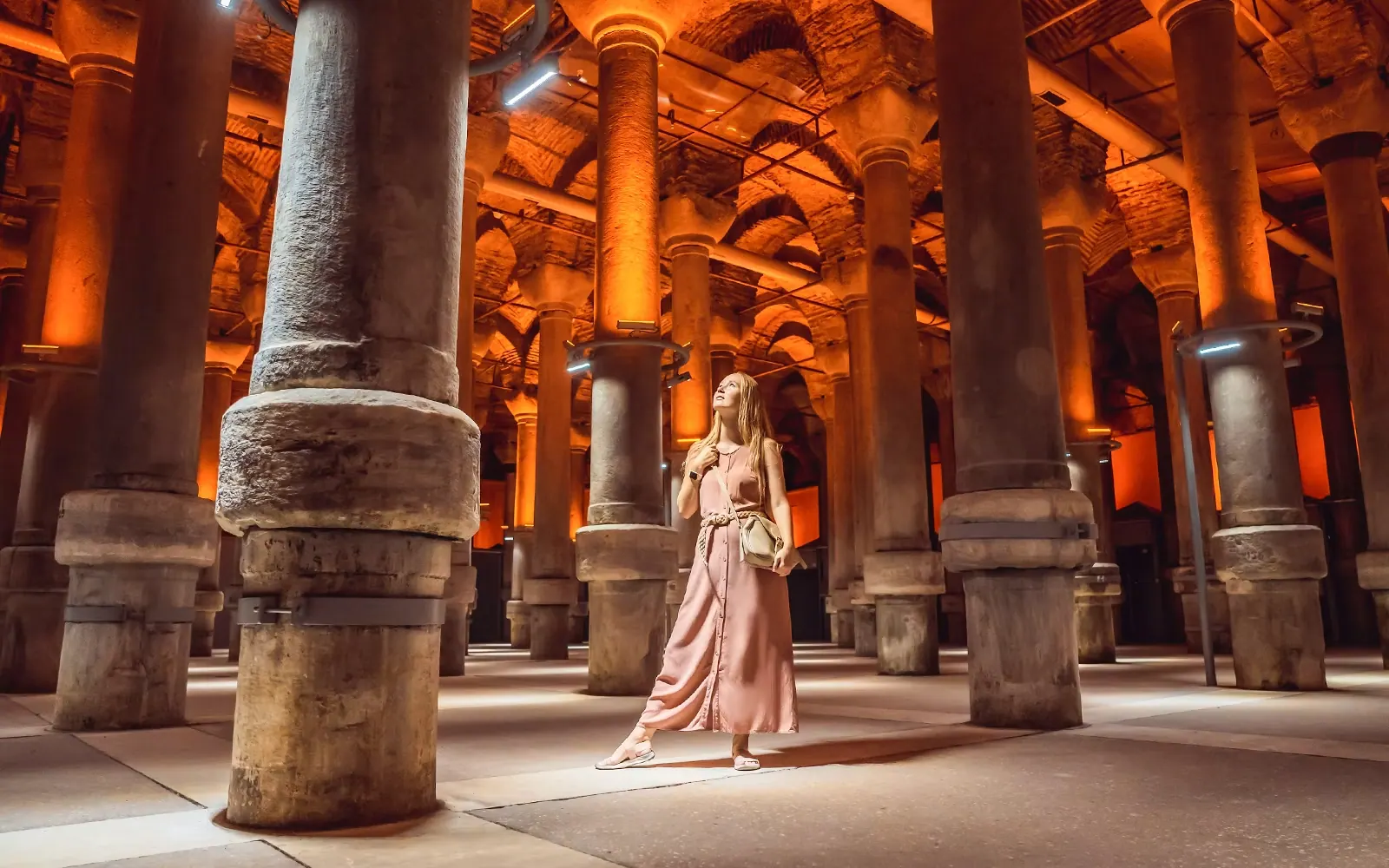
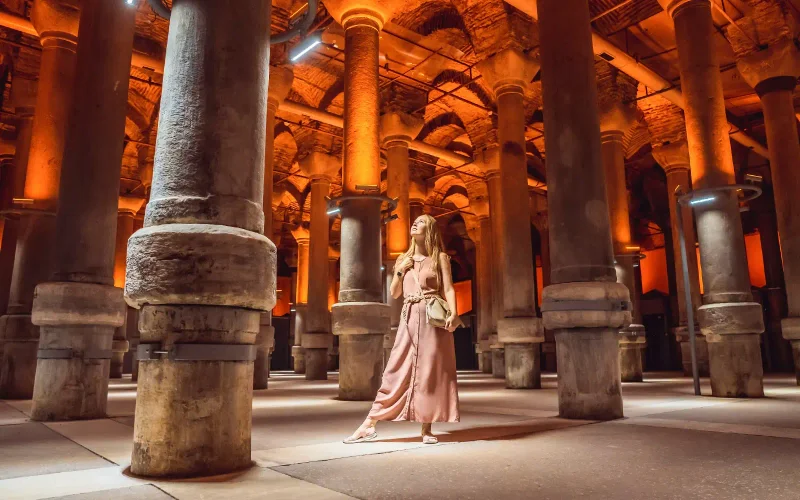
- Basilica Cistern. Underground and dry, the most rain-proof sight in the city. About 40 minutes inside.
- Turkish and Islamic Arts Museum. In the İbrahim Paşa Palace on the Hippodrome. Carpets, manuscripts and an ethnographic section. €17 for foreign visitors.
- Istanbul Archaeology Museums. Three buildings next to Topkapı, with the Alexander Sarcophagus and finds from across the empire. €15.
The short walks between these sights are a few minutes each. An umbrella is enough.
Palaces: which parts are indoors
Topkapı Palace is half indoor and half outdoor. The courtyards are open to the sky, and you cross them between sections. The Harem, the Treasury, the relic rooms and the kitchens are all indoors. On a wet day, see the indoor sections and save the terrace views for a dry hour. Topkapı is closed on Tuesdays.
Dolmabahçe Palace is better in the rain. Almost all of the visit is inside, in the state rooms and the great ceremonial hall, and you only cross the garden from the gate. It is closed on Mondays. Our Dolmabahçe Palace private tour includes the ticket.
Covered bazaars and shopping
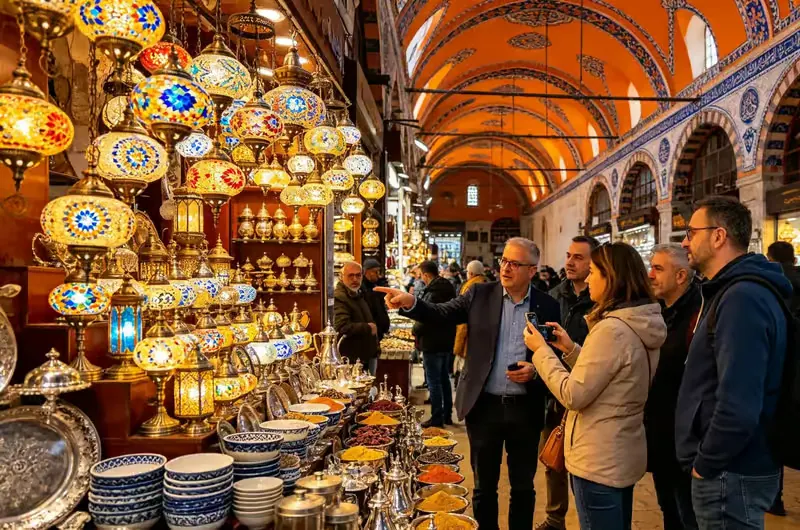
The Grand Bazaar is the classic rainy-day stop. It is a covered market of streets, inns and courtyards where you can spend two or three hours without stepping outside. It is closed on Sundays.
The Spice Bazaar in Eminönü is also covered, smaller and easier to see in an hour. The streets between the two bazaars are open-air and steep, and they get slippery in the rain, so a taxi or car between them is reasonable.
For a guided version with time to bargain, our private shopping tour of the Grand Bazaar and Spice Market starts from $90 per person. If you want modern shops, the large malls in the business districts and the shops at Galataport in Karaköy are all under cover.
Museums outside the old city
A wet day is a good excuse to see the museums that most visitors skip. Many of them are private and closed on Mondays.
- Istanbul Modern, Karaköy. Turkish modern and contemporary art in a waterfront building. Open Tuesday to Sunday, until 20:00 on Fridays.
- Pera Museum, Beyoğlu. Orientalist paintings, including "The Tortoise Trainer", plus changing exhibitions. Open Tuesday to Saturday 10:00–19:00 and Sunday 12:00–18:00.
- Rahmi M. Koç Museum, Hasköy. Industrial and transport history on the Golden Horn: cars, trains, aircraft, ships and a submarine. Good with children. Closed on Mondays.
- Chora Church, Edirnekapı. Now the Kariye Mosque, with some of the finest late Byzantine mosaics and frescoes in the world. Reopened in 2024; foreign visitors pay €20. Visits pause at prayer times.
- Museum of Innocence, Çukurcuma. Orhan Pamuk's museum built around his novel. Small, odd and indoors. Closed on Mondays.
Hammams, ceremonies and long lunches
Some of the best things to do in Istanbul are indoors anyway.
- A Turkish bath. A hammam is warm, steamy and the perfect answer to a cold, wet day. Historic baths in Sultanahmet, Cağaloğlu and Tophane all take visitors; book a time slot in advance.
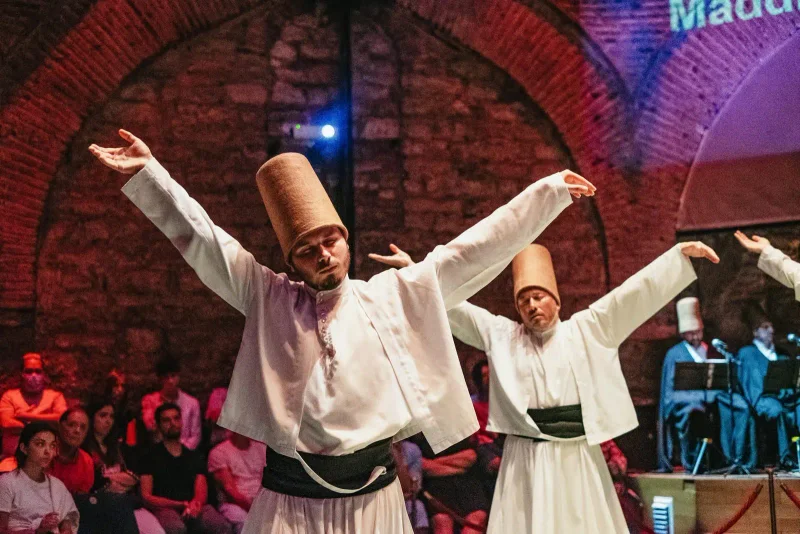
- A whirling dervish ceremony. About an hour of music and the sema in a hall. Our sema ceremony with reserved seating works well as an early-evening plan.
- A slow meal. Istanbul restaurants are built for long lunches: meze, soups, grills and tea. A covered food walk, with stops inside shops and small eateries, still works in light rain. See our private Istanbul food tour page.
- A ferry with a heated cabin. The commuter ferries have indoor saloons with windows and tea. Crossing from Eminönü or Karaköy to Kadıköy on a grey day is still a view. Our self-guided Bosphorus ferry guide has the routes.
A full rainy-day plan
This plan keeps you under cover for most of the day. Swap Topkapı for Dolmabahçe on a Tuesday, and the Grand Bazaar for the Spice Bazaar on a Sunday.
| Time | Plan | Under cover? |
|---|---|---|
| 09:00 | Hagia Sophia (go early, the queue is outside) | Inside; queue outdoors |
| 10:15 | Basilica Cistern | Fully underground |
| 11:15 | Turkish and Islamic Arts Museum | Fully inside |
| 12:30 | Lunch near the Hippodrome | Inside |
| 13:45 | Topkapı Palace: Harem and Treasury | Mostly inside, courtyards open |
| 16:00 | Grand Bazaar | Fully covered |
| 18:00 | Hammam or dervish ceremony | Inside |
| 20:00 | Dinner in Sirkeci or Karaköy | Inside |
With children. Keep the plan shorter and build it around the places children remember. The Basilica Cistern, with its columns standing in water and the two Medusa heads, is usually the favourite. The Rahmi M. Koç Museum on the Golden Horn, with its trains, cars, planes and a submarine you can walk through, can fill a whole wet afternoon. A ferry crossing with tea and simit in the cabin counts as an outing in its own right. Leave the long palace visits for adults with patience, or limit Topkapı to the Treasury.
On a short stay. If you only have one wet day out of three, swap the plans around rather than lose the outdoor sights. Put the Bosphorus, Galata and the walks in Balat on the drier days, and use the rain for the museums, palaces and bazaars you would have visited anyway.
With a private guide and car, the gaps between stops shrink to a few minutes and you do not have to wait for a tram in the rain. Our Istanbul private car with driver page explains how that works.
Getting around in the rain
- The tram. The T1 tram runs through the old city, past Sultanahmet, Gülhane and Eminönü, and on to Karaköy and Kabataş. It is crowded in the rain but keeps you dry.
- Marmaray. The rail tunnel under the Bosphorus links Sirkeci with Üsküdar on the Asian side, all underground.
- Taxis. Harder to find when it rains, and traffic gets slower. Use an app or ask your hotel.
- Shoes. The old city's streets are stone and steep in places. Wear shoes with grip. Our what to wear in Istanbul guide has a packing list for each season.
Tours that cover this
- Basilica Cistern Private Tour: Ticket Included, Topkapı Optional: from $150 per person, 6 to 8 hours.
- Hagia Sophia Small-Group Tour with Entry Ticket, Blue Mosque and Bazaar: from $120 per person, 6 hours.
- Private Istanbul Shopping Tour: Grand Bazaar and Spice Market Guide: from $90 per person, 6 hours.
- Whirling Dervish Sema Ceremony with Reserved Seating: from $60 per person, 1 hour.
For dry-weather ideas too, see our list of things to do in Istanbul.
Frequently Asked Questions
What is the rainiest month in Istanbul?
December is the rainiest month, with an average of about 99 mm of rain over 16 rainy days, according to the Turkish State Meteorological Service. January is close behind with 89 mm. July is the driest month, with about 22 mm and only three rainy days on average.
Is it worth visiting Istanbul in the rain?
Yes. Most of Istanbul's main sights are indoors, including Hagia Sophia, the Blue Mosque, the Basilica Cistern, the palace interiors and the Grand Bazaar. Winter rain usually comes in showers, so you get dry spells too, and the queues at the big sights are shorter in the wetter months.
What can I do in Istanbul on a rainy Sunday?
On a Sunday the Grand Bazaar is closed, but almost everything else is open. Spend the morning at Hagia Sophia and the Basilica Cistern, the afternoon at Topkapı Palace or Dolmabahçe Palace, and finish at the Spice Bazaar, a hammam or a dervish ceremony. Istanbul Modern and the Pera Museum also open on Sundays.
Is the Basilica Cistern good on a rainy day?
It is the best sight for a rainy day, because it is fully underground and you never step outside once you are in. Expect a queue at the entrance at busy times, and wear shoes with grip because the walkways can be damp. Allow about 40 minutes inside.
Which Istanbul museums are closed on Mondays?
Dolmabahçe Palace is closed on Mondays, as are most private museums, including Istanbul Modern, the Pera Museum, the Rahmi M. Koç Museum and the Museum of Innocence. On a rainy Monday, choose Hagia Sophia, the Blue Mosque, the Basilica Cistern, Topkapı Palace and the Grand Bazaar.
Is the Grand Bazaar fully covered?
Yes, the main part of the Grand Bazaar is under a roof, with covered streets, inns and courtyards where you can spend hours dry. Some outer streets and the routes down to the Spice Bazaar are open to the sky. The bazaar is closed on Sundays, so plan a wet Sunday around the palaces and museums instead.
What should I wear in Istanbul when it rains?
Wear shoes with grip, because the stone streets in the old city get slippery. A compact umbrella and a light waterproof jacket are better than a heavy coat, since you will be in and out of buildings. For mosques, women need a scarf, and everyone needs covered knees and shoulders.
Can I take a Bosphorus cruise in the rain?
Yes. Commuter ferries and most tour boats have heated indoor saloons with large windows, and private yachts have covered decks. Views are softer on a grey day but still worth it. In strong wind, some smaller boats may not sail, so check on the day.
Sources: Turkish State Meteorological Service, official climate statistics for Istanbul, 1950–2025 (mgm.gov.tr); Republic of Türkiye Ministry of Culture and Tourism museum price tables (muze.gov.tr); Istanbul Modern visitor information (istanbulmodern.org); Pera Museum visitor information (peramuseum.org); Directorate General of Foundations on the Kariye Mosque visitor plan — checked 6 November 2026.
Private tours in Istanbul
Basilica Cistern Private Tour: Ticket Included, Topkapi Optional
Your own licensed guide takes you through the Basilica Cistern, entrance ticket included, and you can add Topkapi Palace or Hagia Sophia for a fuller day.
Dolmabahce Palace Private Tour: Guide, Ticket & Optional Topkapi
Tour Dolmabahce Palace with a licensed private guide and your ticket included, stop for photos on the Bosphorus waterfront and add Topkapi Palace if you wish.
More things to do in Istanbul
- Things to Do in Istanbul: Sights, Neighbourhoods and Local Tips
- Things to Do in Sultanahmet: Old City Sights in Walking Order
- Things to Do on the Bosphorus: Cruises, Villages, Palaces and Forts
- Things to Do in Istanbul at Night: An Area-by-Area Guide
- Things to Do in Galata, Karaköy and Beyoğlu: A Walking Route
- Things to Do in Kadıköy: Moda, Market Streets and the Asian Side
- Things to Do in Balat and Fener: Golden Horn Streets and Churches
- Free Things to Do in Istanbul: What Costs Nothing in 2026
- Romantic Things to Do in Istanbul: Sunsets, Boats and Dinners
- Things to Do in Istanbul with Kids: Family Plans That Work
- Unusual Things to Do in Istanbul: Iron Church, Old Walls, 1875 Tünel
- Things to Do in Istanbul in Winter: Weather, Indoor Sights, Tours
- Things to Do in Istanbul in Summer: Heat, Islands and Evenings
- Things to Do in Istanbul in December and on New Year's Eve
- Ramadan in Istanbul 2027: Dates, Iftar, Mosque Visits and Eid
Related guides
- Things to Do in Istanbul at Night: An Area-by-Area Guide
- Things to Do in Istanbul in December and on New Year's Eve
- Things to Do in Istanbul in Summer: Heat, Islands and Evenings
- Things to Do in Istanbul in Winter: Weather, Indoor Sights, Tours
- Things to Do in Istanbul with Kids: Family Plans That Work
- Things to Do in Istanbul: Sights, Neighbourhoods and Local Tips
- Things to Do in Kadıköy: Moda, Market Streets and the Asian Side
- Things to Do in Sultanahmet: Old City Sights in Walking Order
- Things to Do on the Bosphorus: Cruises, Villages, Palaces and Forts
- Topkapı Palace Guided Tour: Harem, Treasury and 2026 Tickets
- Touristanbul: Is Turkish Airlines' Free Layover Tour Worth It?
- Turkey Teeth Cost: What Sets the Price of Implants, Veneers, Crowns