

 Istanbul
Hippodrome of Constantinople (Hippodrome Square)
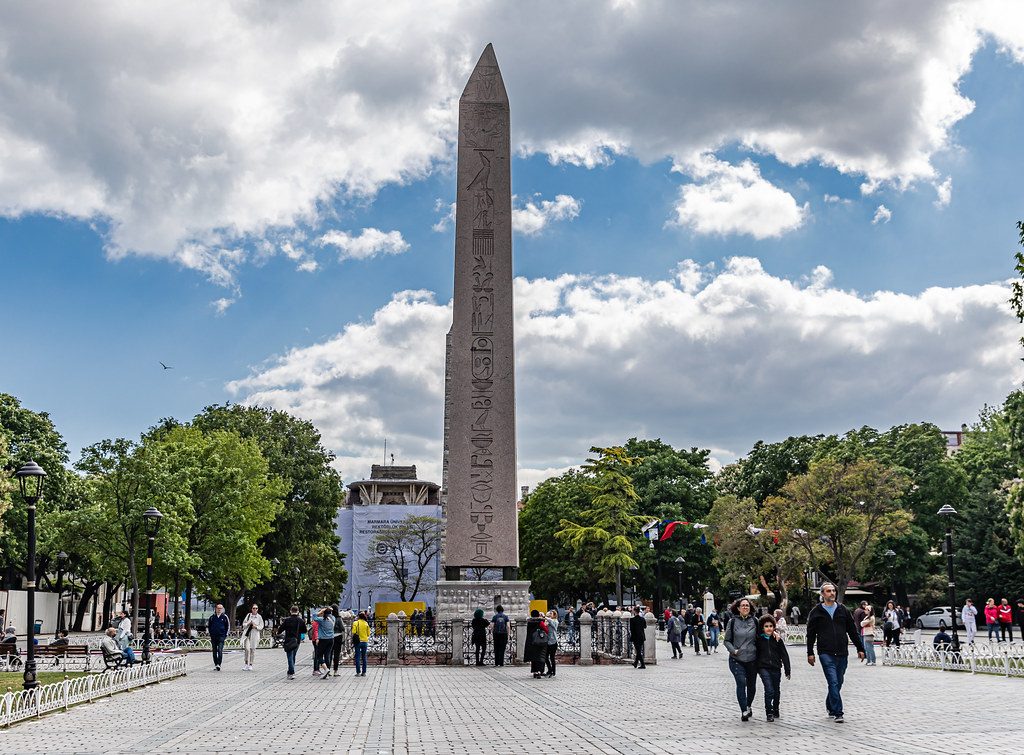
The Hippodrome hosted chariot races in Byzantine Constantinople. Today the old track is Sultanahmet Square, open to all at no cost, and three monuments still line it: an obelisk from Egypt, a bronze column of twisted serpents taken from Delphi and an obelisk of Byzantine stonework.
Tours that visit Hippodrome of Constantinople
Private Istanbul Tour with a Licensed Guide: 1, 2 or 3 Days
Book your own licensed guide in Istanbul for one, two or three days and explore the Old City, Golden Horn and Bosphorus at a pace that suits your interests.
Hagia Sophia Small-Group Tour with Entry Ticket, Blue Mosque & Bazaar
The Hippodrome, Blue Mosque, Hagia Sophia and Grand Bazaar in a small group, with central hotel pick-up and entry tickets included.
Most people walking between the Blue Mosque and Hagia Sophia cross the Hippodrome without realising they are on an ancient racetrack. Sultanahmet's long, open square keeps the outline of the Byzantine stadium, which seated up to 100,000 people. Three monuments still stand on its central barrier, and the oldest is around 3,500 years old.
Key facts
| Item | Details |
|---|---|
| Hours | Always open; it is a public square |
| Closures | None, although sections may be fenced off for events or works |
| Entry for foreign visitors | Free |
| How long | 20-30 minutes, more with a guide |
| Where | Sultanahmet Square (At Meydani), next to the Blue Mosque. T1 tram to Sultanahmet |
| What to wear | No dress code |
History in brief
Around 203, Emperor Septimius Severus started a stadium on this spot, and Constantine the Great made it bigger when he moved his capital here in 330. It was never just a sports venue. The Blues and the Greens, its chariot teams, carried political weight. In 532 their riots, known as the Nika revolt, almost brought down Justinian and set much of the city on fire, including the church that came before today's Hagia Sophia. When the revolt was put down inside the stadium, thousands were killed. In 1204 the Fourth Crusade carried off its bronzes, among them the four horses that today stand in St Mark's, Venice. In Ottoman times the seating had already been stripped for building stone, and the arena served as a parade ground named At Meydani, the Horse Square.
Highlights
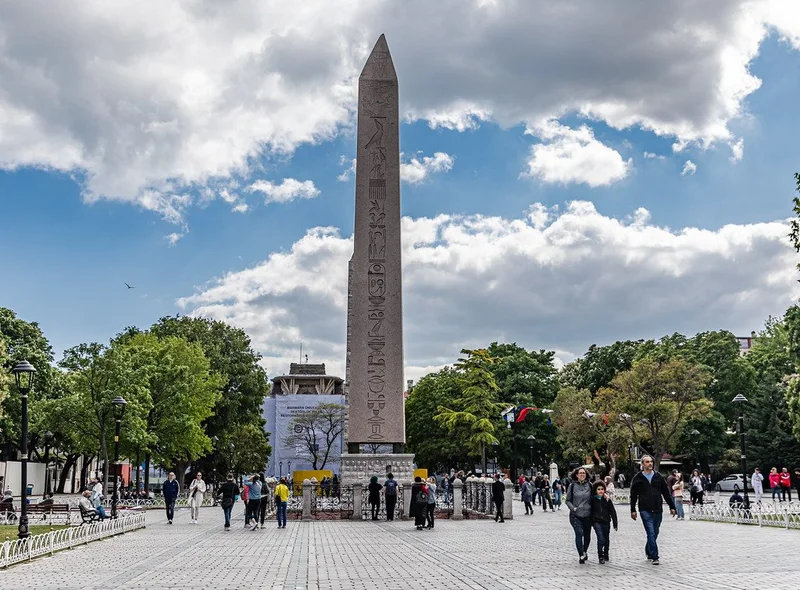
- The Obelisk of Theodosius. Carved in the 15th century BC for Pharaoh Thutmose III, it first stood at Karnak, Egypt. In 390 Emperor Theodosius I had it raised here. Only its upper section survived the transport. Study the marble base: in its reliefs the emperor appears with his family in the imperial box, watching the races.
- The Serpent Column. This twisted bronze column was cast after the Greeks beat the Persians at Plataea in 479 BC, and it stood at Apollo's temple at Delphi until Constantine moved it to his new capital. The snakes lost their three heads long ago; one head sits in the Archaeology Museums of Istanbul.
- The Walled Obelisk. This one is built from rough blocks of stone and used to be covered with gilded bronze plates. Constantine VII restored it in the 10th century, and the crusaders stripped it.
- The German Fountain. Kaiser Wilhelm II presented this eight-sided domed fountain in memory of his 1898 visit. Walking tours usually meet here.
- The sphendone. The stadium's curved south end survives below the square, towards the Marmara, as a massive vaulted wall.
When to go
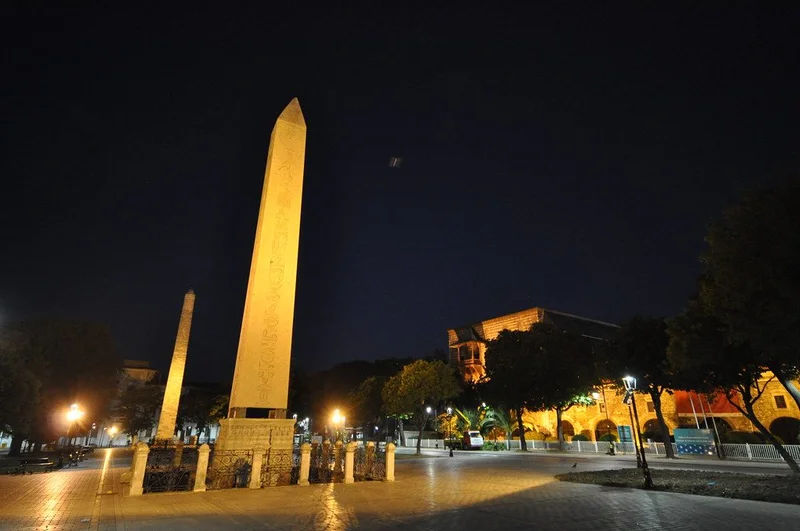
Come early in the morning or after dark. After dark, floodlights pick out the Blue Mosque and the obelisks, and the square is quieter. In Ramadan, the square fills on evenings with a festive crowd and food stalls. Summer afternoons offer little shade.
Almost all Old City tours cross the square, and good guides stop at the obelisk base to explain the reliefs. Our morning group tour of Hagia Sophia, the Blue Mosque and the Grand Bazaar begins its walk here, at the German Fountain, and our private evening tour sets off from the floodlit square before heading over to Taksim and Istiklal.
Tips
- The Museum of Turkish and Islamic Arts, housed in Ibrahim Pasha's 16th-century palace along the square's west side, is worth an hour for the carpets.
- Behind the Arasta Bazaar, a short walk to the south, the Great Palace Mosaic Museum shows floor mosaics from the imperial palace once next to the Hippodrome.
- Simit and roasted corn sold on the square cost more than a few streets back.
- Around the fountain, people posing as "guides" without a licence will approach you. Real licensed guides carry an official ID card.
Our Istanbul guide lists more Sultanahmet sights.
Frequently Asked Questions
Can you still see the Hippodrome of Constantinople?
The stadium has gone, but Sultanahmet Square follows its outline, and three monuments of the old central barrier still stand. The curved retaining wall at the southern end can also still be seen.
How old is the obelisk on Sultanahmet Square?
About 3,500 years. Made for Pharaoh Thutmose III, the Obelisk of Theodosius was shipped from Egypt and erected in 390 AD in the Hippodrome.
Do you pay to enter the Hippodrome?
No. Anyone can walk in at any hour; it is a free public square.
Why is the year 532 famous at the Hippodrome?
That year the Nika riots broke out there, as the chariot-racing factions rose up against Emperor Justinian. Large parts of the city burned, and the revolt finished with a massacre in the stadium.
How much time does the Hippodrome need?
Twenty to 30 minutes is enough for the German Fountain, the Serpent Column and both obelisks. Allow a bit more if a guide is explaining the reliefs.
More places to see in Istanbul
- Balat and Fener (Fener and Balat)
- Basilica Cistern (Yerebatan)
- Beylerbeyi Palace
- Blue Mosque (Sultanahmet Mosque)
- Bosphorus Strait (Bosphorus Cruise)
- Camlica Hill and Camlica Mosque
- Chora Church (Kariye Mosque)
- Dolmabahce Palace
- Emirgan Park
- Fatih Mosque
- Fener Greek Orthodox Patriarchate (Aya Yorgi)
- Galata Bridge and Eminonu
- Galata Tower
- Grand Bazaar (Kapalıçarşı)
- Hagia Irene (Aya Irini)
- Hagia Sophia (Ayasofya)
- Istanbul Archaeology Museums
- Istanbul Modern
- Istiklal Avenue and Taksim (Istiklal Street)
- Kadikoy and Moda
- Little Hagia Sophia (Kucuk Ayasofya)
- Maiden's Tower (Kız Kulesi)
- Miniaturk
- Nuruosmaniye Mosque
- Ortakoy Mosque (Buyuk Mecidiye Mosque)
- Pera Museum
- Pierre Loti Hill and Eyup Sultan Mosque
- Princes' Islands (Adalar)
- Rumeli Fortress (Rumelihisarı)
- Rustem Pasha Mosque
- Spice Bazaar (Egyptian Bazaar)
- Suleymaniye Mosque
- Sultanahmet Square
- Topkapi Palace
- Turkish-Islamic Arts Museum (Ibrahim Pasha Palace)
- Yildiz Palace and Yildiz Park