

 Istanbul
Rustem Pasha Mosque
Rustem Pasha Mosque is a compact work by Sinan, raised above the Tahtakale market shops a short walk from the Spice Bazaar. Its porch and inner walls carry some of the best Iznik tilework in the city. There is no entry fee, yet most people pass the stairway up to it without noticing.
Istanbul's finest Iznik tiles are not found in a palace. They line a modest 16th-century mosque built for Rustem Pasha, set one storey above the street in Tahtakale, the wholesale quarter between the Spice Bazaar and the Golden Horn. You pay nothing, you rarely queue, and often there is hardly anyone inside. Locating the entrance is the only real challenge.
Key details
| Item | Details |
|---|---|
| Hours | About 08:30 to 18:30; no sightseeing during the five daily prayers (October 2026) |
| Closures | Friday noon prayer; visitors are usually let back in from around 14:30 |
| Entry | Free |
| Visit length | 20 to 30 minutes |
| Where | Hasircilar Caddesi in Tahtakale, roughly 200 m from the Spice Bazaar heading west; the nearest stop is Eminonu on tram T1 |
| What to wear | Cover shoulders and knees; women need a headscarf, and scarves are normally offered at the entrance |
Background
Rustem Pasha served Suleiman the Magnificent as grand vizier and was married to Mihrimah, the sultan's daughter. He ranked among the wealthiest figures of the era and funded several of its best buildings. Mimar Sinan designed this mosque, which went up between about 1561 and 1563 and was finished soon after Rustem Pasha died.
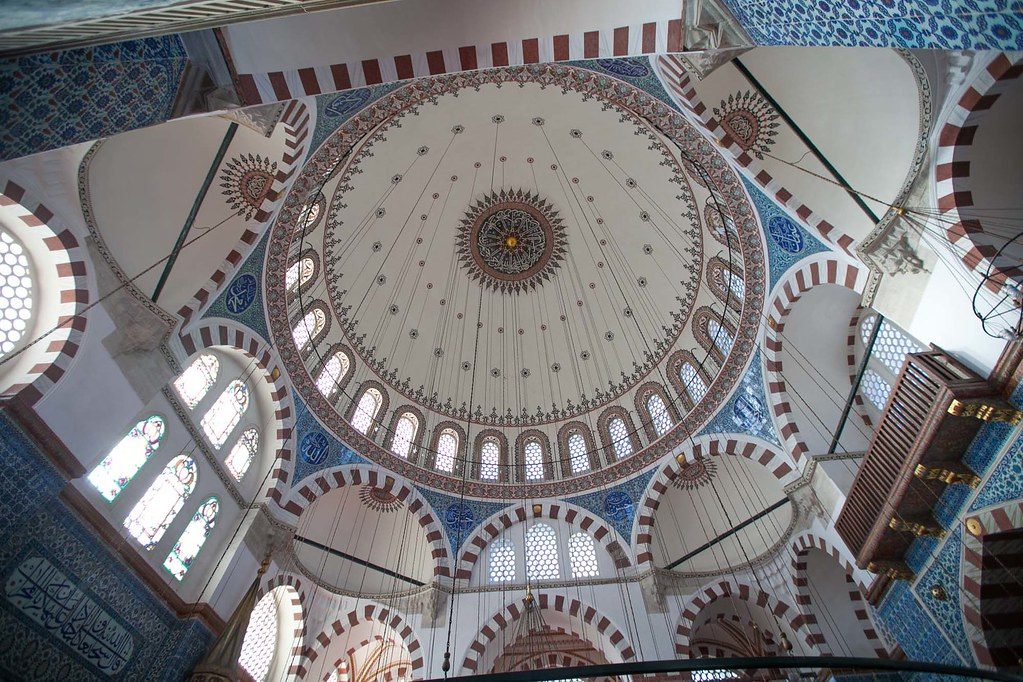
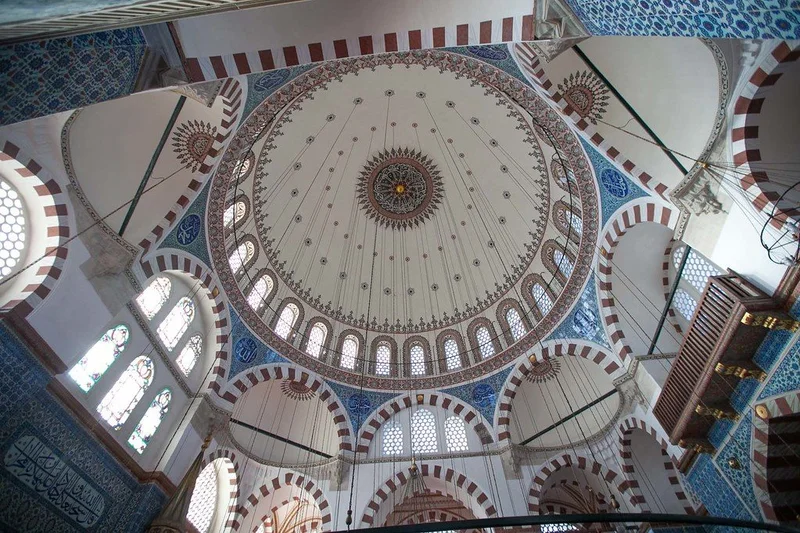
Ground in this busy commercial district cost a great deal, so Sinan set the prayer hall on a raised base. Below it he placed vaulted shops whose rents were intended to fund the mosque, and those shops are still in business. The hall itself is close to square. Eight supports hold up a central dome, with small semi-domes filling the corners, so the interior feels unexpectedly spacious for so cramped a plot.
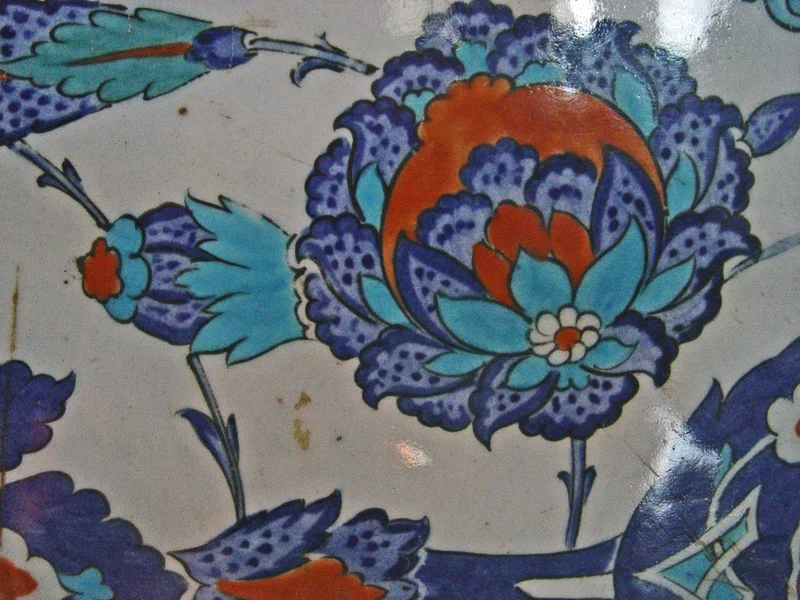
The tiles were made in Iznik when its kilns were at their height. Rustem Pasha had the money for the very best and put them on every surface: the porch, the walls, the columns and the mihrab. Some 2,300 tiles in roughly 80 designs cover the building. Restoration work from around 2017 to 2020 cleaned the interior and strengthened the structure.
Highlights
- The portico. Even before entering, study the outer wall of the porch. Its panels show tulips, carnations and hyacinths in cobalt blue, turquoise, and a raised tomato-red glaze that Iznik potters managed only in the 1560s.
- The mihrab wall. The tilework is thickest around the prayer niche and across the wall that frames it.
- The piers. Look closely at the tiled faces of the columns. On some panels the tiles were cut and shaped to follow curves, something you seldom see.
- The dome. Its painted ornament and tiers of windows keep the hall light, even under a grey sky.
- Individual tiles. Move slowly along the side walls. Some panels combine different patterns, and a few tiles are obvious later replacements, which helps you pick out the originals.
Finding the entrance
There is no wide forecourt here. Starting at the Spice Bazaar, head west on Hasircilar Caddesi, a tight lane full of spice sellers, kitchenware stores and coffee shops. Keep an eye on your left for a modest stone doorway with a stairway rising between two shops. At the top you reach a terrace and then the courtyard before the prayer hall. Arriving at the large junction with Kantarcilar Caddesi means you have walked past it.
It takes around two flights of steps before anything resembling a mosque comes into view.
When to go
The quietest time is a weekday morning from 09:00 to 11:30, ahead of the midday prayer. Porters and handcarts fill the lane below from morning to evening, so come on foot rather than in a taxi. On a Friday, wait until about 14:30. On Sundays many surrounding shops shut and the lane is far calmer, while the mosque stays open outside prayer times.
Rustem Pasha Mosque is not a listed stop on any of our tours, though several come within a few minutes' walk. The Istanbul Private Shopping Tour: Grand Bazaar & Spice Market gives you four hours in both bazaars with a local guide, from US$200, and the guide can include the mosque if you ask. For the main Old City sights together with Eminonu, look at the Istanbul Half-Day Private Old City Tour & Hagia Sophia Fast-Track.
Practical tips
- Remove your shoes at the door and carry them in one of the bags supplied.
- You may take photos without flash, but leave worshippers out of your pictures.
- Pair the visit with Suleymaniye Mosque, ten minutes away up a steep hill, and you see Sinan's grandest and his most intimate work in one morning.
- In the lane below, keep your bag in front of you; few streets in Istanbul are more packed.
- The stairs mean wheelchair users cannot reach the mosque.
For other sights in the area, see our Istanbul destination page.
Common questions
Does it cost anything to visit Rustem Pasha Mosque?
No, entry needs no ticket. You may leave a donation, though nobody expects one, and sightseeing stops during prayers.
What makes Rustem Pasha Mosque well known?
Its Iznik tilework. Roughly 2,300 tiles in some 80 designs cover the porch, walls, columns and mihrab, all produced when the Iznik workshops were at their peak.
Where is the entrance to Rustem Pasha Mosque?
From the Spice Bazaar, go west along Hasircilar Caddesi and watch the left side for a small stone doorway with steps between the shops. Since the mosque sits on a raised platform, you cannot see it from the street.
How much time should I allow at Rustem Pasha Mosque?
Most people need 20 to 30 minutes. If you love tiles, an hour passes quickly.
Who was the architect of Rustem Pasha Mosque?
Mimar Sinan, chief architect of the Ottoman court, built it in about 1561 to 1563 for Rustem Pasha, grand vizier to Suleiman the Magnificent and married to his daughter.
More places to see in Istanbul
- Balat and Fener (Fener and Balat)
- Basilica Cistern (Yerebatan)
- Beylerbeyi Palace
- Blue Mosque (Sultanahmet Mosque)
- Bosphorus Strait (Bosphorus Cruise)
- Camlica Hill and Camlica Mosque
- Chora Church (Kariye Mosque)
- Dolmabahce Palace
- Emirgan Park
- Fatih Mosque
- Fener Greek Orthodox Patriarchate (Aya Yorgi)
- Galata Bridge and Eminonu
- Galata Tower
- Grand Bazaar (Kapalıçarşı)
- Hagia Irene (Aya Irini)
- Hagia Sophia (Ayasofya)
- Hippodrome of Constantinople (Hippodrome Square)
- Istanbul Archaeology Museums
- Istanbul Modern
- Istiklal Avenue and Taksim (Istiklal Street)
- Kadikoy and Moda
- Little Hagia Sophia (Kucuk Ayasofya)
- Maiden's Tower (Kız Kulesi)
- Miniaturk
- Nuruosmaniye Mosque
- Ortakoy Mosque (Buyuk Mecidiye Mosque)
- Pera Museum
- Pierre Loti Hill and Eyup Sultan Mosque
- Princes' Islands (Adalar)
- Rumeli Fortress (Rumelihisarı)
- Spice Bazaar (Egyptian Bazaar)
- Suleymaniye Mosque
- Sultanahmet Square
- Topkapi Palace
- Turkish-Islamic Arts Museum (Ibrahim Pasha Palace)
- Yildiz Palace and Yildiz Park